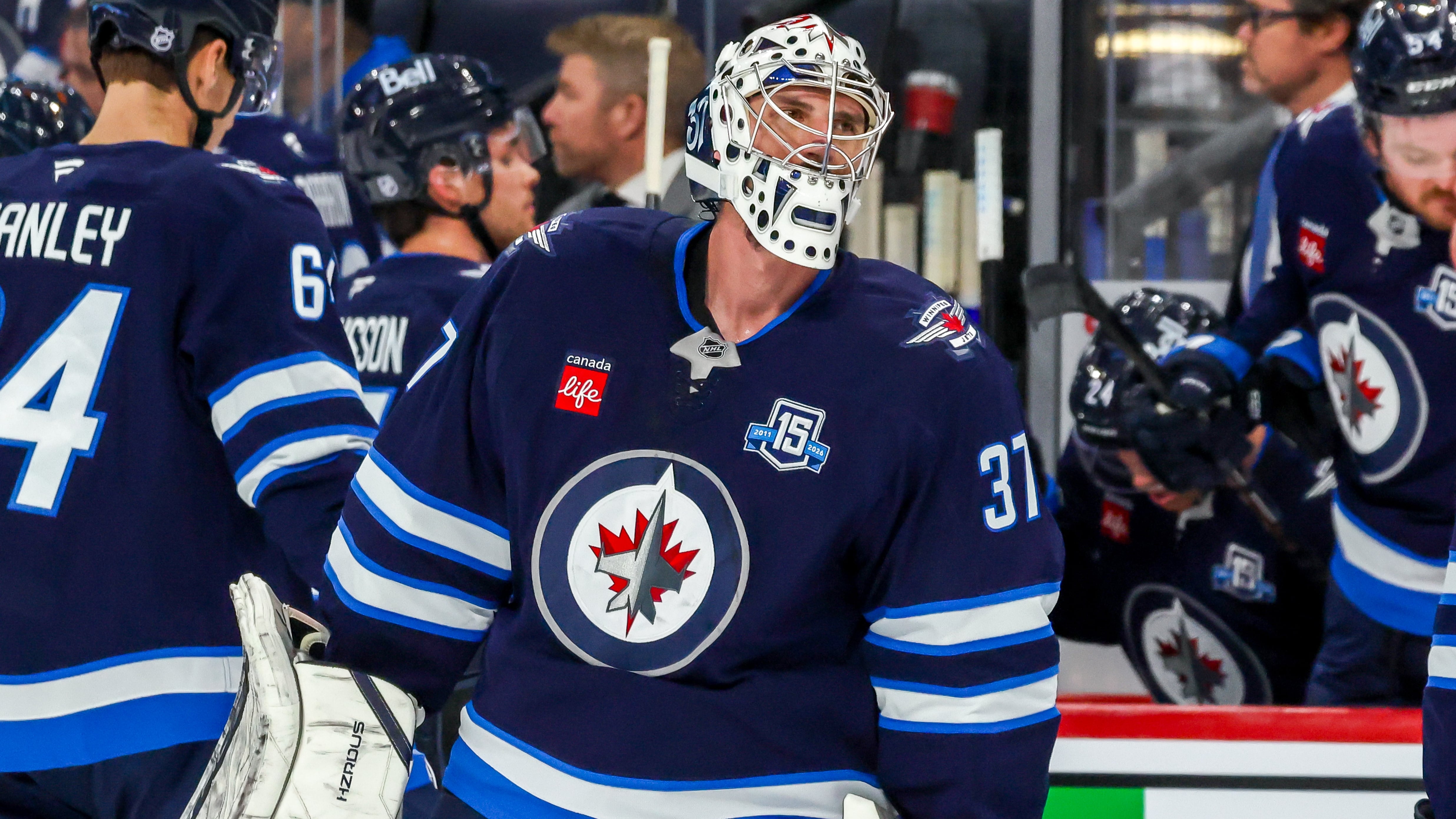
It feels as though Connor Hellebuyck’s days in Winnipeg are numbered.
Trade speculation is flying around the 33-year-old goalie, and for good reason. It’s rare a three-time Vezina Trophy winner becomes available, and acquiring this sort of goaltending outperformance could turn any playoff team into a Stanley Cup contender.
The ask from Winnipeg in any trade is going to be extraordinary. The real questions front offices are weighing: What is the likelihood Hellebuyck continues to look like one of the league’s best goalies over the final five years of his contract? Are teams still acquiring a superstar, or potentially lining up to overpay ($8.5 million AAV through the 2030-31 season) for past performance?
We don’t have a crystal ball to answer this sort of question, but Hellebuyck is far from the first goaltender to continue playing at an elite level into his 30s. To that end, I was curious about how some of Hellebuyck’s contemporaries have aged, and if the decision to acquire a goaltender at this moment is one that would skew higher risk or higher reward.
To do this, I looked at every goaltender with qualified performance (at least 300 shot attempts faced) from the 2007-08 regular season through the 2025-26 regular season, and affixed a percentile ranking of their play that season.
Our preferred unit of measure here will be Goals Saved Above Expected on a per game basis. This allows us to compare goaltenders across different playing environments and with different shot profiles faced. It’s also a better pulse on how goaltenders performed than raw save percentage, which is heavily impacted by the overall defensive quality of a team.
Hellebuyck, over his career, has routinely graded as one of the league’s best. Other than a rough sophomore season, he’s been arguably the league’s best at erasing goals:
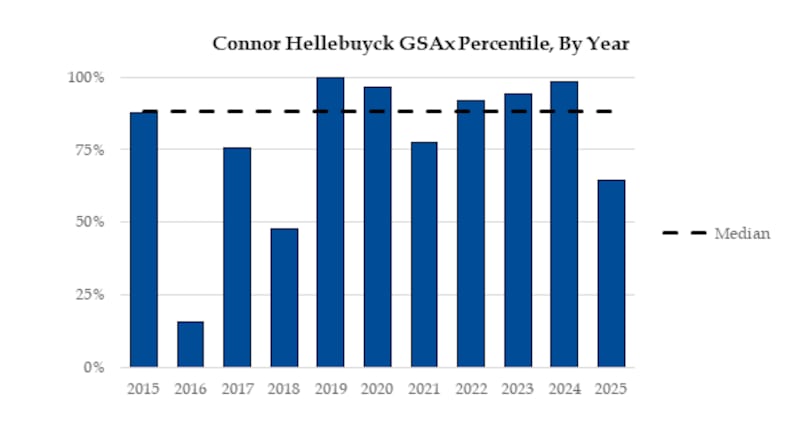
It goes without saying that if any interested trade partner knew they were getting something close to the Hellebuyck we witnessed during the 2019-24 stretch, they’d start writing some blank cheques. But that’s why it’s important to analyze Hellebuyck’s peers. Is there meaningful risk of a player at this age and with this degree of mileage falling off quickly?
Let’s look at a group of 15 goaltenders who check several notable boxes for us. The first is they played better than league average across hundreds of games heading into their age-33 season, where Hellebuyck is now. The second is they played at least three more years (in other cases, five more years, until the end of Hellebuyck’s current contract), which allows us to measure performance in the twilight of their respective careers. How did this composite group fare?
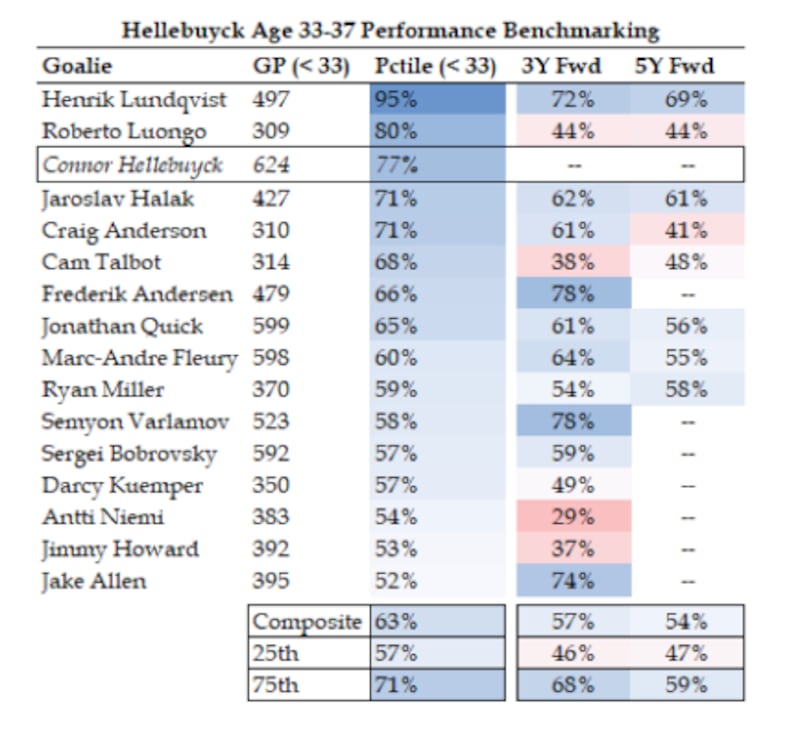
Quite well, it turns out. Our 15 comparable goaltenders played at the 57th percentile over the next three seasons (through Hellebuyck’s age-35 year), and at the 54th percentile over the next five seasons, though that group is considerably smaller.
What’s intriguing to me is Hellebuyck’s two most logical comparables – Henrik Lundqvist and Roberto Luongo, also two of the best goaltenders of the past few decades – trended in different directions in the late stages of their respective careers. Lundqvist was incredible until the finish, while Luongo regressed closer towards the league average in his final years with the Florida Panthers.
There are two important caveats worth considering for teams eyeing a potential trade. The first is the obvious one: durability and availability are critical at the goaltender position, and this table is blind to older goalies who aged out of the league in varying off-seasons from injuries and the like. While teams do get salary cap relief when a player retires, the assets they give up in a potential trade are not recoupable.
The second is that this group, though it held up well in most instances, did see performance slippage on two different fronts: relative to their historical play, and relative to their peers around the league. Or, said another way: the base case for Hellebuyck is that he likely remains a good goaltender for several years forward, but the likelihood of him looking like the league’s preeminent puck stopper starts to diminish from this point forward.
Data via Natural Stat Trick, NHL.com, Evolving Hockey, Hockey Reference