
John Chayka and the Toronto Maple Leafs wasted little time making a big splash this off-season, announcing a major sign-and-trade with the Tampa Bay Lightning on Friday night to acquire defenceman Darren Raddysh. Raddysh subsequently signed an eight-year, $68-million contract with Toronto.
There’s no doubt Toronto is a better team, perhaps substantially so, with Raddysh in the mix. Though a late bloomer, Raddysh has been an anchor inside of Tampa Bay’s top four the past three seasons, hallmarked by last year’s explosive 22-goal, 70-point campaign.
A physical player with a booming shot, Raddysh should provide serious juice from Toronto’s blueline. And this isn’t a one-season wonder – Raddysh has been good for several years now.
In short, I don’t find much reason to be skeptical of the player today. But the contract is a different debate. Spending $68 million on a 30-year-old defenceman is not without risk, notably because the deal takes him through the 2033-34 season. It made me wonder what comparables are out there for Raddysh, and how we might be better able to qualify that risk.
First, let’s look at a composite average of Raddysh’s comparables and see how they played through their age-35 season. Comparables include 30 defenders who produced within the range of Raddysh based on Goals Above Replacement (a unit of measure that captures the total number of goals a player contributed to their team relative to a replacement-level player, via Evolving Hockey).
This is what that data looks like:
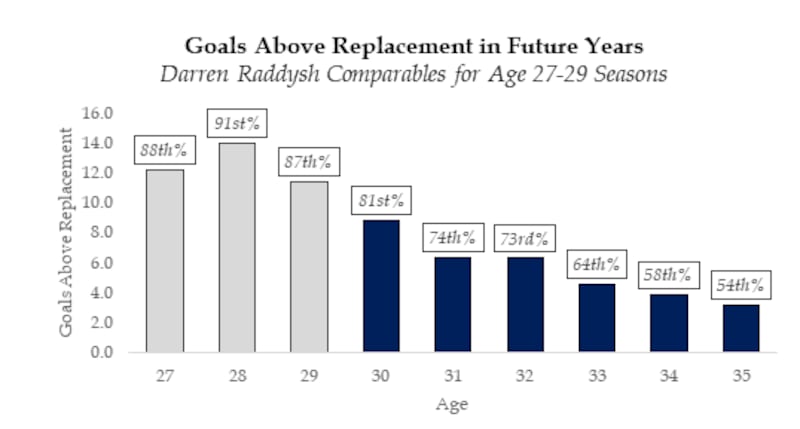
Are Raddysh’s best seasons behind him? Almost certainly. But that’s not uncommon for big free-agent signings for players in their late 20s and early 30s. The question is about sustainability and longevity, and, encouragingly for the Maple Leafs, most of Raddysh’s peers play well deep into the future. Most comparables played around the 75th percentile for defender performance for at least the next three seasons, and the drop-off isn’t extraordinary in the later years.
For higher-end comparables, let’s look at some defenders who played like Raddysh did in that age 27-29 window and identify those who continued outperforming well into the future:
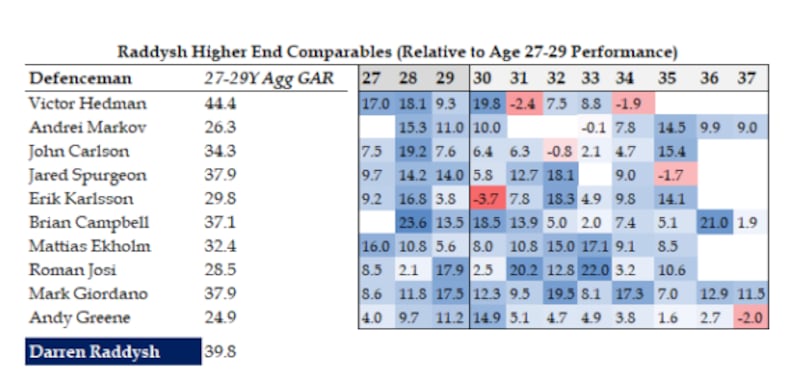
One of the things that stands out to me in this group of ideal comparables – they’re high-end skaters and great distributors of the puck. I’m not sure Raddysh falls into the quality skater category, but his on-ice vision and playmaking were on full display in Tampa Bay, which is what made him so appetizing to Toronto’s front office. If Raddysh ages a la Mark Giordano or Brian Campbell, Toronto’s investment is going to be proven wise.
Let’s look at lower-end comparables. Some of these players accumulated mileage quickly and started fighting injuries; injuries not consequential enough to shorten their career, but enough to impede their game. And though we may not have rosy memories of the late stages of many of these players, it should be emphasized they played very well in the same window Raddysh did:
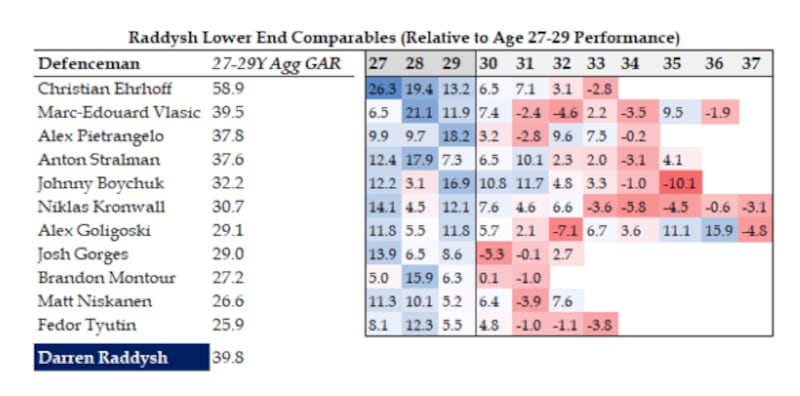
Players like Christian Ehrhoff, Alex Goligoski, and even more recently Brandon Montour, saw similar explosions in offensive production, but their future seasons saw (a) steep regression in individual offensive production; and (b) a meaningful decline in performance from their baselines in most other phases of the game.
What’s notable to me is we don’t see a bunch of guys completely falling off a cliff and rendering themselves unplayable; this is more so guys who look like first pairing-calibre defenders accelerating into becoming a No. 3 to No. 5 defenceman in the lineup. That’s not problematic in and of itself, but cap-constrained teams don’t want to bury big contracts on third pairs if they can avoid it. It’s not just inefficient, it impedes your ability to invest elsewhere in a hard-cap league.
For my money, this is mostly good news for Maple Leafs fans. I think the risk of Raddysh blowing up on Toronto is quite small. He’s been a quality player for Tampa Bay for three seasons now and the base case is he continues playing well for at least the next three or four years.
However, the reward may not be as tantalizing either – it’s likely we have seen the best of Raddysh, as was true for most of his peers in years past.
Data via Natural Stat Trick, NHL.com, Evolving Hockey, Hockey Reference