For years, Canada has produced elite soccer players almost by accident.
The country has had stars who emerged from immigrant communities, private academies, university programs and the academies of Major League Soccer clubs.
It’s had players who left home as teenagers, players who were overlooked until late adolescence, players who were identified early but developed unevenly and players who succeeded because their families had the financial flexibility and stubbornness to keep pushing them through a fractured system.
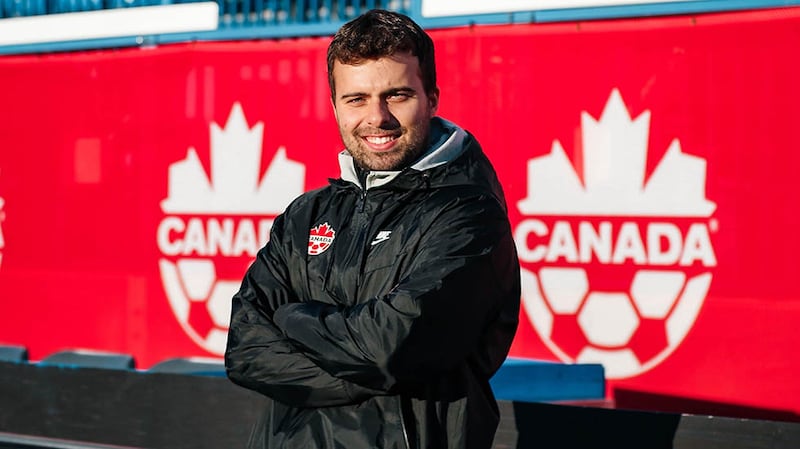
What Canada has rarely had, though, is a true national plan for its best teenage players. Danilo Veselinovic, Canada Soccer’s director of technical development, has been hired to imagine one.
Earlier this year, Veselinovic, a 24-year-old former player who completed both his undergraduate and master’s degrees at Harvard, began working with Canada Soccer on an ambitious and still-evolving project: a national youth residency centre that would bring together the country’s best 15- to 17-year-old players at a yet-to-be-built national training centre, placing them in a daily environment designed to resemble the best development programs in Europe and the United States.
“Canadian youth players rarely train and compete together,” Veselinovic said in an interview with TSN. “That’s the biggest problem that we have. The best talent at the Whitecaps in Vancouver will never play with the best talent in Toronto unless we have the national team camp. But week-long national team camps are not for development. You can only do so much in seven days.”
The concept would begin with the best 30 15- to 17-year-old players in the country. The players would live with billet families, train together, attend school and compete for part of the year in domestic leagues, including MLS Next and a Canadian minor professional league such as the Ontario Premier League, formerly League1 Ontario.
For the rest of the year, the players would travel abroad to play games in Europe, South America and Asia, exposing them to the speed, pressure and tactical sophistication that young Canadian players too often do not encounter until much later.
“Having young players spending two years in an environment where they are training with the best of the best on a daily basis is going to make them better,” Canada Soccer’s newly hired sporting director Kenneth Heiner-Moller said in an interview.
“Being part of a program like this is also a way to help players get match minutes domestically and maybe international exposure if the group is also travelling abroad as part of playing games. This would make the residency function as a solid stepping stone for the next step for players with the highest potential in Canada or abroad.”
Canada Soccer is trying to solve a challenge created by geography, uneven resources and a fragmented youth soccer landscape. The country has produced stars, including national team players Alphonso Davies, Jonathan David and Moïse Bombito, but the pathway remains inconsistent.

Many of the country’s best young players either leave for Europe, depend on MLS academies or rely on families with enough money and patience to navigate an expensive, confusing system.
The project is still in the planning stage. Canada Soccer has issued a request for information inviting municipalities, provincial associations, postsecondary institutions and other possible partners to express interest in hosting or supporting a future national training centre. (The federation envisions a location with a number of indoor and outdoor pitches, meeting room areas and dining and medical facilities.)
The residency program could begin before a training centre is built, Veselinovic said, with Canada Soccer operating as a tenant at an existing facility before eventually moving into the national centre. The proposed residency would be tied to a wider scouting and identification structure, including regional U-15 camps across the country.
Those camps, Veselinovic said, could be staged four or five times a year in different regions, bringing together 40 or 50 players at a time. Some could be small-sided tournaments, designed to give players more touches and evaluators more data. Others could mimic national team camps, giving young players a first taste of the rhythm and demands of international soccer.
“We give them the feeling of, ‘You are seen by the national team,’” he said.
That may sound basic. Veselinovic said it is not happening enough. Right now, he said, Canada Soccer relies heavily on video scouting, club recommendations and coaches’ existing networks. The organization has lists, but not always first-hand knowledge.
“That’s the first big step,” he said. “We don’t see them.”
The proposed residency would begin with two cohorts: roughly 15 players from the U-16 age group and 15 from the U-17s, forming a pool of about 30. The younger players would be pushed to adapt by training and competing with players a year older and the larger roster would give coaches flexibility: on one weekend, 16 players might travel to play an MLS Next match while the remaining players stay home to train or play an OPL game.
(Diana Matheson, a former women’s national team player who is the co-founder of the women’s professional Northern Super League, said in an interview with TSN that leaders in Canadian women’s soccer at this point prefer to have elite teenage players, like AFC Toronto forward Kaylee Hunter, play in the NSL rather than a national residency.)
The point, Veselinovic said, is not merely to create a stronger team. It is to create more meaningful training days and games.
In the current academy model, he said, travel can hollow out a week. A player may leave Friday for an away match, play Saturday, travel home on Sunday, rest Monday and then have only two useful training days before the next match.
“This is not an efficient way to develop talent,” he said.
Under the residency model, players who do not travel could remain in the training environment and still get high-level work.
The annual calendar is designed to expose players to a broader soccer world. Veselinovic envisions starting in January by sending players to Europe for a month to play against major academies that are in preseason and looking for opponents.
After a short break, the team could travel to the United States to play against college programs. Then it would move into a domestic season, perhaps in MLS Next. Later in the year, the team could travel to South America or host international opponents in Canada.
“If you have a national facility with six pitches, we can host 12 countries,” Veselinovic said. “Why not?”
The timing of the project is not accidental. FIFA has shifted its U-17 World Cups to an annual format beginning in 2025, with the men’s tournament expanded to 48 teams and staged in Qatar for five editions, while the women’s tournament expanded to 24 teams and is being held annually in Morocco through 2029.
That change alters the development calendar. Countries no longer have two years to prepare for the next U-17 cycle. They need a permanent pipeline.
“You have to be prepared for it,” Veselinovic said. “Now, you don’t have two to four years to find new players. You have to be on task.”
The model has obvious benefits, he said. It could raise the level of Canada’s best young players and it could give national team coaches more time with them. It could expose clubs and private academies to higher standards and it could make Canada more competitive with Europe for players who might otherwise leave at 14 or 15.
“If we can provide this top environment, including schooling, in our domestic environment, we can compete with Europe,” Veselinovic said.
But the project also raises difficult questions, including: Who gets selected for the residency? Who pays? How does it protect 15-year-olds living away from home? How does it work alongside MLS academies, private clubs and provincial associations, whose cooperation will be essential?
Veselinovic’s answer starts with standards.
He said Canada Soccer is building a talent identification department, not simply a traditional scouting department. The goal is to create what he called “a net around Canada” — a network of provincial bodies, clubs, regional events, scouts and data.
“One network, many eyes on many, many moments,” he said.
He is skeptical of simply hiring an army of scouts. He said the United States spends millions of dollars annually on scouting, but Canada should not try to copy that model. The first step, he said, is defining what Canada Soccer is looking for at each position and at each age.
“This has to start with clear standard setting and clear communication of what are we looking for as Canada Soccer,” Veselinovic said. “This is the centre-back for us. This is the striker for us. This is what it looks like when they’re 14.”

That matters because some players develop late or play out of position. Veselinovic cited Bombito, now one of Canada’s most promising defenders, as the kind of player who may not have looked like an obvious future international at 14.
“He didn’t look great, but he looked physical, strong, fast,” Veselinovic said. “Nobody assesses the persona right now. But how is he as a person? This has, most often, a bigger effect.”
The proposed model borrows from systems abroad. Veselinovic has studied the IMG Academy, which acted as a residency program for USA Soccer before the MLS was formed and its teams opened their own academies, Right to Dream, a private company that operates academies across Africa, Hungary’s Puskas Academy, Morocco’s Mohammed VI Academy, and USA Hockey’s National Team Development Program.
USA Hockey began its development program in 1996 by creating two teams, an under-18 team and an under-17 one, basing them in Ann Arbor, Mich., to centralize their training. Both teams started playing games in the fall of 1997 against teams from the NCAA, U.S. Hockey League and a Tier II junior hockey league. The program has produced five No. 1 overall NHL picks and has helped to develop 99 alums who have been drafted in the first round.
The daily schedule of a national residency would be demanding. Players would attend online school, supervised by a director of student services and teaching staff. They would train in the morning, have lunch, continue school, then return for individual work, gym sessions, multisport training or personal development.
Veselinovic said the model would allow the players to travel without interrupting education.
“It’s like an online prep school,” he said. “By the time you’re 17 and played [in] the World Cup, you’re also ready for college.”
Housing would be handled through billet families rather than dormitories. Veselinovic said he strongly prefers that model, but only with proper oversight, including psychological support and daily monitoring.
He cited conversations with former Canadian national soccer team players who had mixed experiences as teenagers living away from home, including one who told him their billet family locked the fridge to prevent them from eating too much, and another who had to walk home alone late at night after training.
“[These are] all issues that, when you’re 14, 15 years old, you might not voice as hard,” he said. “We can’t have that happen.”
Players would eat breakfast, lunch and dinner at the training facility, with billet families responsible mainly for snacks and the home environment.
Officials with several elite soccer programs said they were excited about the prospects of a national residency program.
“Not only would players have the opportunity to train daily alongside other elite athletes, but it is also important that they learn to live like professionals within those environments,” Ryan McCord, general manager with Waterloo United, a minor soccer club in Waterloo, Ont., said in an interview with TSN. “With relatively few academies in Canada, we still lag behind many nations in providing access to these types of high-performance settings.”
McCord said it would be critical to create the right culture within such a development centre.
“We cannot bring in talented young players, already receiving praise for their abilities and then simply cater to them,” he said. “Instead, we need to create an environment that develops leadership, ownership, humility, work ethic, accountability and teamwork.”
The projected cost of the men’s residency would be roughly $3 million a year, plus facility rental, until a national centre is built. Veselinovic said that figure is comparable to the cost of running an academy in Canada. He said federation officials are already discussing funding models with potential donors.
The technology would also be expensive. Veselinovic is interested in tools from companies including SpeedCourt (a training system reportedly used by Bayern Munich that combines agility drills, cognitive decision-making, and footwork) and a SoccerBot, a circular 360-degree training room that allows players to strike balls against interactive targets and simulate decision-making scenarios. Together, he estimated, those tools could cost roughly $600,000.
“The other option is to go with cheap tools,” he said, “and then you need 20 different tools to cover what they do.”
The embrace of technology notwithstanding, Veselinovic insists the central idea of a residency program would be culture.
He said the Canadian system, influenced partly by hockey, too often rewards winning games at young ages rather than developing players. In his view, a U-15 coach should not be treated as lower status than a U-20 coach. Different age groups require different expertise.
“It’s all about development,” he said.
He described conversations with coaches who worry about losing friendly matches.
“I don’t care if you lose the game,” he said. “What I care about is how the player developed, the feedback we gave the player. Did we create something bigger for them? Some belonging, feeling the badge? That’s way, way, way bigger development.”
That may be the most radical part of the proposal: not the facility, not the travel, not the technology, but an attempt to change how Canadian coaches define success for 15-year-olds.
The 2026 World Cup has given Canadian soccer an unprecedented stage. But the players who enter this residency would not be built for 2026. They would be built for 2030, 2034 and beyond.
For Veselinovic, that is the point. Canada has already shown it can produce exceptional players. The question is whether it can build a system that produces more of them, more frequently, with fewer left behind by distance, money or accident.
“One flag, one standard,” he said.