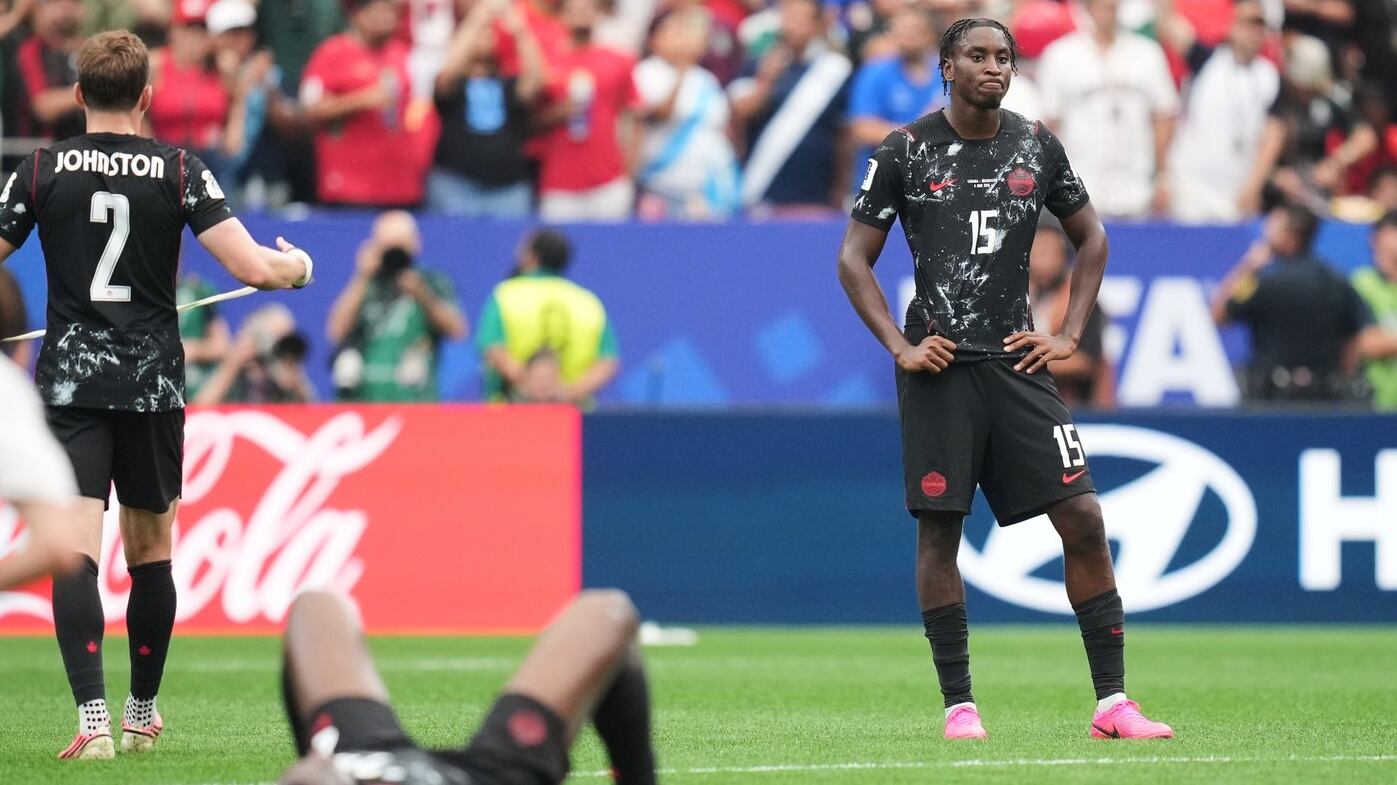
Now that there’s been some time to digest Canada’s 3-0 loss to Morocco that ended their 2026 FIFA World Cup in the Round of 16, it’s time to look back at what went right and what went wrong through Canada’s unprecedented five-match run at world football’s biggest tournament.
While the World Cup was an unequivocal success for Canada Soccer, that doesn’t mean it was without causes for concern. There is a real danger here of waving away any aspects of failure because of how colossal a win everything was on the whole. But failing to acknowledge what didn’t work raises the spectre of complacency, and that could go a long way to derailing the ascendent trajectory the program remains on right now.
First, the good and there’s a lot of it – for the first time in three tournaments, Canada won a match and advanced from the group stage. Though nobody wanted to put a ceiling on what this team was capable of before the World Cup, reaching the Round of 16 would have been considered a rousing success. The team scored eight goals in its five matches, eclipsing its previous high of two set at Qatar 2022.
Dealing with injuries to several crucial players, Jesse Marsch’s men stepped up in a big way to cover for their fallen teammates and produce some fine performances with the play of Luc de Fougerolles, Alistair Johnston and Stephen Eustàquio especially commendable.
De Fougerolles, in particular, was a revelation. His poise in central defence belies his experience level with the 20-year-old Fulham product having played only nine fewer matches for Canada since his senior debut in 2024 (18) than he has in his entire professional career (27). With the team’s most influential centre-back, Moise Bombito, still not 100 per cent and Derek Cornelius picking up a knock during the tournament, Canada would have been lost without de Fougerolles.
The Davies dilemma
Central to the discussion of any talk of injuries will be the availability, or lack thereof, of captain Alphonso Davies. The Bayern Munich left-back’s entire World Cup consisted of a 15-minute cameo – albeit a very effective one – in Canada’s 1-0 win over South Africa in the Round of 32. Injured in Bayern’s Champions League semi-final second leg against Paris Saint-Germain in mid-May, the 25-year-old Davies’ status was a major talking point in the weeks leading up to the World Cup. Cagey about his availability in the days prior to the tournament, everything boiled over for Canada, Marsch and Davies when he didn’t feature in the Morocco loss.
Was Davies’ injury and everything surrounding it handled well by Marsch and the team? That’s a matter of opinion. Outside of the opening draw to Bosnia and Herzegovina, Marsch insisted that his captain was available to play. When he didn’t play in Canada’s 2-1 loss to Switzerland to wrap up the group stage, Marsch insisted that he successfully used Davies as “a decoy” to get the Swiss worried about him. How successful the use of the decoy was in a match that Canada ultimately lost is also a matter of opinion.
When Davies didn’t appear among the substitutes warming up during Saturday’s match, there was a palpable sense of disappointment amongst Canada supporters, but there should not have been any surprise. Davies’ entire season, never mind the past couple of months, had been riddled with injury. He made just 23 appearances across all competitions this past season, his fewest number of games played since turning pro nearly 10 years ago.
What was a surprise, though, was the reaction from some corners with Davies’ toughness and commitment to the program being questioned. Marsch said after the game that even though an MRI on his injured hamstring came back clean, his player didn’t feel right and didn’t believe he could contribute. While there has undoubtedly been tension among Canada, Davies and his reps and Bayern over his injuries and the handling of them in recent years (much of it stemming from his torn ACL in a rather meaningless third-place match in the 2025 CONCACAF Nations League), the idea that Davies wouldn’t have performed if he were able is absurd.
The backlash to his absence was enough that Davies felt the need to release a social media statement.
“Personally, this tournament was one of the toughest challenges of my career,” Davies wrote. “After suffering a hamstring injury, I wasn’t able to perform at the level I know I’m capable of. It hurts knowing I couldn’t give my all when my team and my country needed it most.
“That said, I don’t believe in excuses. Football is full of setbacks, and how you respond is what defines you. This disappointment will only motivate me to recover, work harder, and come back stronger than ever.”
The mirage of offence
Although Davies’ availability dominated the narrative surrounding the team over the past two weeks, there was another glaring absence that flew under the radar a little bit – Canada’s lack of firepower. If you didn’t watch the matches and saw that Canada managed eight goals in its five matches, it appears be more than respectable on paper. That stat, though, is very misleading.
Six of Canada’s eight goals came against Qatar. Four of those six goals came with Qatar down a man. Three of those four goals came with Qatar on nine men. In other words, Canada scored just two goals over the other four matches and notched only four goals in five matches during 11v11 play.
So what happened to Canada’s offence? It was largely just not there. Obviously, Davies’ absence hurt there, as well. As witnessed when he came on during the BIH match, his presence altered the game and Canada went on the front foot almost instantly after he subbed on. But chalking up the anemic offence to no Davies is reductive at best and specious at worst.
Canada’s attacking players had their chances and many of them were spurned. The biggest culprit of that was Jonathan David. The Juventus man leaves the tournament with three goals, but all of those came in the Qatar match. Outside of it, he was largely ineffective.
Prior to scoring against Qatar, David last scored for Canada in a 2-2 friendly draw against Iceland in March. Both of those goals came from the spot. David has now scored in two of his past 13 matches in a Canada shirt. The team needs so much more from the man expected to be its biggest attacking threat. His free kick from just outside the area with Canada trailing Morocco 1-0 was especially poor.
But David wasn’t alone in misfiring. Cyle Larin was the only Canada player to score in more than one match and he, too, could have had more. Both Larin and Tani Oluwaseyi, who had a glorious opportunity to open the scoring against Morocco, missed a number of good chances over the course of the tournament. They weren’t helped with largely anonymous turns on the wing by Liam Millar and Tajon Buchanan, the latter of the two being one of the team’s major disappointments. While Promise David, who scored a fine consolation goal against Switzerland on a wonderful setup from Nathan Saliba, shined in his limited action coming off of a broken leg in February, it was evident that he couldn’t be counted on for much more than he managed to give.
What went wrong?
On the other side of the ball, Canada’s defensive effort over the course of the tournament was admirable for the most part, especially considering that Bombito remained compromised and the horrific injury to Ismaël Koné that ended his tournament in the second half against Qatar. Still, there were some lapses that led directly to goals. Had those been cleaned up, we might still be talking about an active tournament right now.
First-choice keeper Maxime Crepeau proved Marsch made the right call in making him the No. 1 with a couple of big stops over his World Cup, including a 10-bell stoning of Breel Embolo early in the Switzerland match. But he was at fault on Johan Manzambi’s goal that made it 2-0 and killed off the match for Switzerland. Crepeau managed to get both hands on his shot, yet it still made it through him. That simply cannot happen in a match that big.
As for the loss to Morocco, when Canada went into the locker room still in a scoreless draw at halftime, there was a foreboding sense that the team might come to regret its inability to get anything from its positive play and attacking for much of the first half. The premonition was proven accurate when Girona’s Azzedine Ounahi scored the first of his two goals just five minutes after the restart. It marked the second time Canada had conceded in the first five minutes of the second half following a 46th-minute goal from Ruben Vargas in the Switzerland game.
The goal itself came from Canada’s own doing. As good as de Fougerolles was over the course of the World Cup, the goal came directly from a needless foul that resulted in a free kick from a dangerous area. With all 10 Canada outfield players deep in the box, Achraf Hakimi rolled the ball to a completely unmarked Ounahi at the edge of the area to use the sea of black shirts as a screen and beat Crepeau. To take nothing away from a finely worked set piece from the Atlas Lions, Canada could have shored up its marking on the play.
While the final scoreline read 3-0, it flattered Morocco. Soufiane Rahimi’s 3-0 goal came with what was almost the final kick of the match after Canada had abandoned all pretenses of defending in order to try to find something at all going forward. What was the actual dagger for Switzerland was Ounahi’s second goal in the 82nd.
After Canada had fallen behind, there was a sense of urgency from the attack with the knowledge that there was going to be vulnerability on the counter. And that’s exactly how Ounahi completed his brace. Morocco broke the other way with Brahim Diaz setting up Ounahi for his second.
Questions could be asked of Eustáquio in the lead-up, though. The Canada midfielder fouled his man, rather half-heartedly, as the play began. Referee Michael Oliver, who at times seemed to be on the verge of losing control of the match with his willingness to dole out bookings, played the advantage and Morocco went on to score. Had Eustáquio been more forceful with his foul and hauled the Moroccan player to the ground, he would undoubtedly have been booked, but he also more than likely would have stopped the play dead. If you’re going to commit to the foul, really go for it. Erasing that goal would have meant nearly 10 minutes of regular time plus eight minutes of stoppage to chase one goal instead of two.
In looking back at Canada’s performance, this was by no means an exercise in downplaying Canada’s achievements or looking to find faults for the sake of it. Retrospect requires a holistic approach and the bad must come with the good even if it’s outweighed. What Canada did over the past weeks was truly commendable and represented a giant step forward for a program that had been moribund and dormant for much of the past four decades. It is absolutely cause for celebration.
But it should also be an exercise in learning. Canada wants to become a fixture at World Cups and took the first step with consecutive appearances for the first time ever. In order for that to come to pass, introspection is required. Every aspect of Canada’s World Cup must be examined and anything that was teachable should be highlighted.
Marsch’s Canada team made the nation proud. What comes next will be just as important.