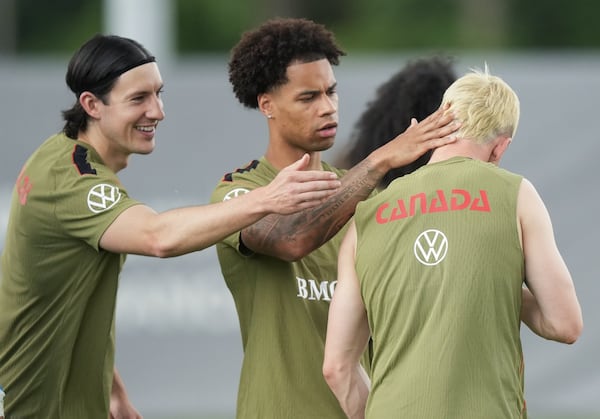
CHARLOTTE — Alfie Jones has been on a journey, trying to discover what, exactly, it means to be Canadian.
As one of the 26 players tabbed to represent Canada at this summer’s FIFA World Cup, the Middlesbrough centre back knew he had some research to do.
He made a giant stride recently, pledging his allegiance to a hockey team.
“I’ve got my team, the Flames, now. Just doing a bit of research on them. It’s been a tough year, but it looks bright for the future,” he said at Canada’s pre-tournament training camp in Charlotte, N.C. “And with the family background, just trying to dive more into that.”
Born in Bristol, England, Jones didn’t grow up thinking he’d wear the Maple Leaf on his chest.
While playing at Hull City, though, he mentioned to teammate Liam Millar that his grandmother was born in Hillcrest, Alta. Millar, a Canadian midfielder, recognized the connection could make Jones eligible to play for the national team.
Jones got his Canadian citizenship in November and played his first game for his adopted country days later.
The 28-year-old defender said he’s been roundly welcomed into the tight-knit squad.
“I’ve never walked into a group like this,” he said. ”The togetherness, how the staff are with the players as well, the connection between everyone, it’s an unbelievable group of guys. So much talent in this group. It’s a pleasure to be involved with it.”
Jones is one of 12 Canadian players — and one of 891 players from around the globe — set to make his World Cup debut this summer.
Getting called up to represent your nation in soccer’s biggest showcase is a special feeling, said defender Niko Sigur.
“This is why I joined the national team, to play on big stages like this,” said the 22-year-old Hajduk Split defender. ”I have to give a lot of credit to the coaching staff and my teammates because they’ve shown a lot of trust in me from when I came in … This is what I want, to play for my country on the biggest stage.”
Half of the 26-man roster named by Canada head coach Jesse Marsch on Friday had not played in a World Cup before.
The newcomers are an eclectic mix, including veteran Orlando City goalkeeper Maxime Crepeau, who missed out on the 2022 tournament in Qatar with a broken leg, and the team’s youngest talent, 20-year-old defender Luc de Fougerolles.
They fill every position, from keepers Crepeau and Owen Goodman (Barnsley), to forwards Promise David (Royale Union Saint-Gilloise) and Tani Oluwaseyi (Villarreal).
Alongside Jones, Sigur and de Fougerolles, Canada’s defence corps includes first-timer Moïse Bombito of OCG Nice, while midfielders Ali Ahmed (Norwich City), Mathieu Choinière (Los Angeles FC), Nathan Saliba (R.S.C. Anderlecht) and Jacob Shaffelburg (LAFC) are also heading to the tournament for the first time.
Shaffelburg wasn’t sure whether he’d make the World Cup roster, in part because of a hamstring injury.
The 26-year-old athlete from Kentville, N.S., knows firsthand what it’s like to miss out on the tournament. He was with the training group in Bahrain ahead of the 2022 World Cup in Qatar, but did not make the final cut.
Shaffelburg went on to excel in the 2024 Copa America tournament, where Canada finished fourth, then struggled at the 2025 Gold Cup, receiving a red card in the nation’s quarterfinal loss to Guatemala.
“Copa was top of the world, I felt like. And then obviously Gold Cup was lowest you could go, for sure,” he said. ”So I can say I felt both top and bottom, the best and worst case scenarios. But I think it’s made me a better player and a better human from that.”
Shaffelburg spent training camp in Charlotte rehabbing a hamstring injury, but is hopeful he’ll be fit to play during the tournament.
When he does get on the field, he hopes his young kids Daisy and Baker will be there, too.
“It’s going to be unbelievable,” Shaffelburg said. ”To see (Daisy) in the stands would be, yeah. It would be unbelievable to wear the Canada jersey and have her there. It would be so cool. And my son too, obviously, but he’s just like a bit of a blob right now.”
The average age on Canada’s roster is 25.3 years old.
A point was made to include a lot of young players on the roster to emphasize the fast, powerful, athletic game Canada wants to play, Marsch said.
“World Cup is a young man’s tournament,” he said. ”The games come fast, the games are fast. And if you go to a tournament with too old of a team, you risk picking up injuries and you risk not being able to meet the standards of how good the games are.”
Veterans also have a critical role to play on the team.
“Having mixed in there some guys who have been there before, have been in big games, who understand what the best games require, that have in-game intelligence and understanding … all of a sudden you have a group that’s in the prime of their careers, performing the best, maybe, in their lives and really ready for a big moment,” the coach said.
Canada’s list of debutantes dropped from 13 to 12 on Saturday when midfielder Marcelo Flores ruptured his anterior cruciate ligament while playing for Tigres UNAL in the CONCACAF Champions Cup final.
Marsch now has until 24 hours before Canada’s first game — a matchup with Bosnia-Herzegovina in Toronto on June 12 — to name a replacement.
This report by The Canadian Press was first published June 2, 2026.
Gemma Karstens-Smith, The Canadian Press