World Cup players were warned before the tournament about a new rule that would result in an immediate red card for anyone covering their mouth when verbally confronting another player.
Officials are actively enforcing that rule change.
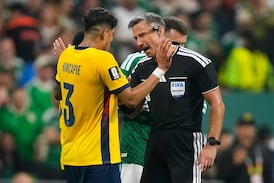
The latest incident came on Tuesday night when Ecuador defender Piero Hincapié was sent off in second-half stoppage time of his team’s 2-0 loss to Mexico in the round of 32. The red card didn’t impact the outcome of the match, which ended moments later.
Hincapié’s red card came after an exchange with Mexico forward Santi Giménez.
Why did FIFA establish the new rule?
FIFA established the new rule to prevent players from hiding abusive, discriminatory or offensive language while on the field.
Nicknamed the “Prestianni Law,” rules for red cards to players at the World Cup were added because of a controversy in international soccer this year.
FIFA president Gianni Infantino pushed for changes after Benfica winger Gianluca Prestianni tried to hide verbal insults toward Real Madrid forward Vinícius Júnior in a Champions League match. Soccer’s rule-making panel, the International Football Association Board, agreed that players can be penalized with a red card if they cover their mouths when verbally confronting another player.
The rule is not mandatory within the Laws of the Game but gives tournament organizers like FIFA the option to use it at their discretion.
The rule change was unanimously approved by IFAB, which includes officials from FIFA and the four British soccer federations, at a special meeting ahead of the FIFA Congress. FIFA’s proposal followed Vinícius, backed by Real Madrid teammate Kylian Mbappé, accusing Prestianni of making a racially charged insult while raising his jersey to cover his mouth during the game in February.
Is Piero Hincapié the only player who has received a red card at the World Cup?
No. Paraguay midfielder Miguel Almirón was the first player to be punished under the new rule when he was sent off in a group match against Turkey for covering his mouth during a confrontation with defender Mert Mulder.
Paraguay won 1-0, but Almiron missed Paraguay’s final group game against Australia. FIFA said that decision was not subject to appeal.
What does it mean when a player receives a red card at the World Cup?
If a player is shown a red card by an official, he is ejected from the match and must serve a one-game suspension in the following match.
The team is forced to play the remainder of the match with 10 players — putting them at a huge disadvantage — but is allowed to start the following match at full strength with 11 players, just not the suspended player. ___
See more of AP’s World Cup coverage here
Steve Reed, The Associated Press