This time between Victoria Day in Canada and Memorial Day in the United States is a good time to evaluate where teams are in a Major League Baseball season.
Everybody has played right around 50 games, so you can get a good read on the quality of a team. As an executive, you’re not only evaluating your own team, but other clubs as well. You can get a sense as to how you stack up against others.
By now, teams atop the standings are generally not just hot teams, they are good teams. Teams at the bottom of the standings are not just cold teams, they are bad teams.
That being said, there are explanations, justifications, and rationalizations that help put surprises and disappointments into perspective. That perspective will determine how much hope and fear teams have as the season unfolds.
For instance, the St. Louis Cardinals are 28-21 yet they have been outscored by five runs. That makes me doubt that they are as good as their record would indicate. Then I look at the fact that they have the fewest strikeouts as a pitching staff, and it makes me believe they’ve been fortunate that the balls that have been put in play have been hit right at the defence, which will likely change over the long run.
On the other hand, the Seattle Mariners have outscored their opponents by 11 runs but are just 24-27. They haven’t gotten the expected production from offensive stars Julio Rodriguez or Cal Raliegh so far either. I expect they will turn it on at some point.
The Dodgers (31-19) and Padres (29-20) are separated by a game and a half in the NL West, but the Dodgers have scored 57 more runs than San Diego and allowed 38 fewer runs. They are close in the standings, but the Dodgers are the much better team.
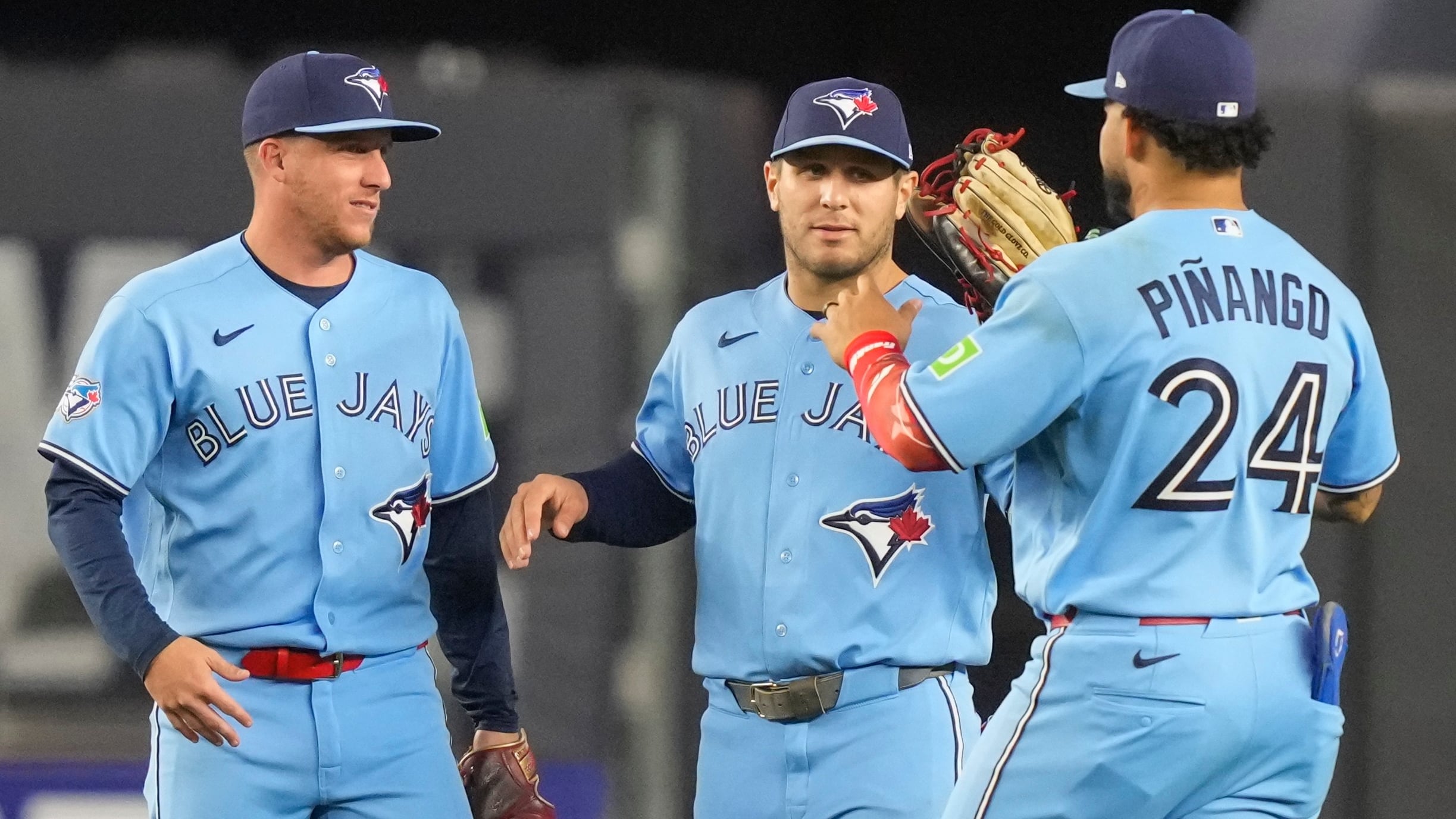
So, what does this all mean for the Blue Jays? It was good that they just played the New York Yankees (30-21) and split the four-game series. It confirms that the Jays (24-27) are comparable to the powers in the AL despite their lesser record. On any given night, the Jays can compete with the big boys.
Clearly, the Jays have suffered from some key injuries: Jose Berrios, Shane Bieber, Cody Ponce, Max Scherzer, Yimi Garcia, Tommy Nance, Joe Mantiply, Alejandro Kirk, Addison Barger, George Springer, and Anthony Santander.
There has been so much starting and stopping because of the injuries, but that can’t be an excuse. Every team has injuries. Someone else on the roster must step up in these moments.
There are good signs that the offence is coming around as Springer homered twice in the series against the Yankees and Vladimir Guerrero Jr. reached base three times on Thursday. Springer and Guerrero are the heart and soul of the team and the offence. The Jays go as they go.
The American League kind of stinks this year: only five of the 15 teams have a winning record and only five have positive run differentials.
The Tampa Bay Rays (33-15) have played phenomenally well. They have the best record in baseball. The Jays are currently 11 games behind the Rays but just 1.5 games out of the third wild-card spot. Other than the Rays, Yankees and Guardians, the American League is limping along, trying to find traction.
The Jays are just fine and can still be considered a strong playoff contender.
Varland looks comfortable in closer role
So far this season, the Jays have used Jeff Hoffman, a bullpen by committee, and now Louis Varland in the closer role.
Varland has been excellent so far, saving all six of his opportunities. Hoffman had blown three of his seven opportunities and had taken three losses.
Varland’s stats resemble those of a dominant closer: 25.2 innings pitched and only 21 hits, a .226 opponent’s batting average, a 0.70 ERA, 37 strikeouts and no home runs allowed. Hoffman’s stats are not: 22 innings pitched with 29 hits allowed, a .309 opponent’s average, 1.68 WHIP and three homers allowed.
Hoffman did get the save on Thursday, as Varland was unavailable after pitching in the previous two games. But it seems clear that, moving forward, Varland is John Schneider’s first choice in the ninth while Hoffman is to be used earlier in the game.
As the season progresses, I expect general manager Ross Atkins to target a reliever or two on the trade market.
Spitting Seeds
With the CBA negotiations looming and the possibility that owners will want to institute a salary cap, it will be interesting to see the strength of their arguments if the standings remain the same as they are now.
Currently, the Rays (28th payroll), Guardians (29th) and Athletics (21st) are leading their respective divisions in the American League. The Brewers (20th) are leading the NL Central again. Those four division leaders are small-market teams that have among the lowest payrolls.
The Chicago White Sox (27th) and St. Louis Cardinals (26th) would be wild-card representatives if the season ended today. The Reds (19th), Pirates (22nd), and Twins (24th) are all within 1.5 games of a wild-card spot.
Sure, the Dodgers (first), Yankees (third), Padres (seventh), Braves (eighth) and Cubs (ninth) and Rangers (15th) would all be playoff teams if the season ended today and they are in the top half of payrolls.
There are five playoff teams in the top 10 in payroll, five in the bottom 10 in payroll and two from the 10 teams in the middle. This certainly would dilute the argument from small-market owners that they can’t compete.
There are two negotiations that will happen for the new labour agreement. First, the owners need to negotiate their position amongst themselves to present to the players. Second, then the owners through the Commissioner’s Office will negotiate a deal with the players.
Based upon the current standings, I think it will be a hard sell for large-market owners to sympathize with small-market owners who feel they are victimized by the current system.
If the owners drop their desire for the salary cap, which the MLB Players’ Association has already made clear is not a structure that they would consider, the CBA negotiations will not be as contentious as anticipated.
Let’s hope that cooler heads prevail.