Following the opening salvos in collective bargaining between Major League Baseball and the MLB Players Association, one thing is clear: The gap between the sides is not just enormous. It's fundamental.
MLB proposed a salary-cap system Thursday, marking the league's first foray into overhauling the sport's economic structure in more than three decades. The long-awaited proposal would set a hard cap of $245.3 million and hard floor of $171.2 million, aiming to shrink the disparity among team payrolls by a significant amount. The league's proposal -- which also called for a 50/50 revenue split and the centralization of all television revenue -- came one day after the MLBPA made a wide-ranging opening offer that called for a soft floor, new definitions of revenue sharing and pay increases for younger players.
The differences between the two show why those around the sport expect a protracted fight leading up to the Dec. 1 expiration of the CBA. This is different than the last negotiation, in which the sides were negotiating money within an agreed-upon system. This time, MLB wants to change the system. The MLBPA does not. And until the sides agree on a framework to govern the sport, the 2027 season will be in peril.
Here is what you need to know about the dueling proposals.
What are the fundamentals of MLB's proposal?
There have never been restrictions on what teams can or can't spend. The league's proposal would codify a hard top and bottom, narrowing the maximum chasm between the highest and lowest spenders to less than $75 million. Players would be guaranteed a 50/50 split of baseball-related revenue, which the league proposed it would define similarly to other capped leagues. MLB also proposed fully sharing local television revenue. Currently, teams share 48% of all local revenue. MLB's proposal carves out local TV, which has been a significant generator of inequity among teams' revenue streams.
The last time MLB proposed a salary cap was in 1994, when the players went on strike and the World Series was canceled. It was a devastating moment for the sport. The league's cap-and-floor proposal Thursday speaks to the near unanimity of owners in their desire to profoundly change how the game operates.
Why does MLB want a salary cap?
The league is positioning its salary cap stance as the panacea to competitive balance issues. Regardless of some small-market, low-revenue teams' ability to construct some of the best teams in baseball -- the Tampa Bay Rays, Milwaukee Brewers and Cleveland Guardians are perennial winners under the current system -- large-market, big-payroll teams have won the past 10 World Series. Combine that with the dominance of the Los Angeles Dodgers and league polling that shows fans want a cap-and-floor system like the NFL, NBA and NHL, and it has emboldened the league to pursue change, even if the union regards a salary cap as a declaration of war.
Multiple owners and high-ranking team officials have told ESPN that stagnating franchise values are every bit as much the motivation for a number of owners as whatever competitive balance a salary cap would ostensibly bring. Perhaps the tepid growth of MLB valuations compared with the other three major men's professional sports is changing -- the San Diego Padres recently fetched $3.9 billion, a record sale for a baseball team -- but owners' calculations are simple: Fixed costs make a business more attractive for prospective buyers. And for organizations that claim to be cash poor, the sale price is paramount to their investment.
What are the fundamentals of the MLBPA's proposal?
The union sees the ascent of baseball in recent years and believes the system itself isn't the issue. It's the teams that aren't willing to spend money to keep up with the game's juggernauts. Thus came the union proposing a "competitive integrity tax" -- a complement to the competitive balance tax that has penalized high-spending teams for most of this century -- that would require teams not spending at least half of the base CBT threshold to forfeit a portion of their revenue-sharing dollars. With a proposed CBT base starting at $300 million, that would mean payrolls of at least $150 million -- almost identical to what MLB proposed, when removing the $23 million in benefits built into its salary-floor number.
Like MLB, the union also proposed changes to revenue sharing through local TV money, with every team contributing $50 million and then two-thirds of whatever remains going to a shared pool that would be distributed equally. MLBPA also proposed significant financial gains for younger players: a near doubling of the minimum salary to $1.5 million (with 10% annual raises) and an expansion of the bonus pool for pre-arbitration players from $50 million to $180 million.
Why is the MLBPA opposed to a salary cap?
Beyond the fact that players think the game is in a good place, they do not want to place artificial limits on their ability to earn. And while a large swath of players do agree that the financial gap between high- and low-spending teams can cause inherent disadvantages, they also know that well-run, thin-budget teams can succeed, and poorly constructed, big-dollar teams can flop.
What the league sees as a competitive-balance issue the union frames as one of competitive integrity. The proposal of the eponymous tax is the union's rejoinder to a cap, through which the league is saying that the teams which spend a lot -- and, ostensibly, are all-in on winning -- must be restricted. The players disagree: The problem, they say, is teams that don't spend are not sufficiently prioritizing winning. A salary cap would penalize owners willing to pay for better players, precisely the opposite, players say, of how those investing in their product should be treated.
Most of all, the union believes that a salary cap is not necessary for competitive balance. With potential bonanzas from national and local television contracts coming after the 2028 season, the league could receive a game-changing cash influx -- particularly if owners are willing to equally split all TV money, as the NFL does. Although revenue sharing is collectively bargained and must be approved by the players, they argue that they don't need to limit their ability to earn money for the owners to share revenue. They regard the two issues as independent, even if they do fall under the same collective bargaining agreement umbrella.
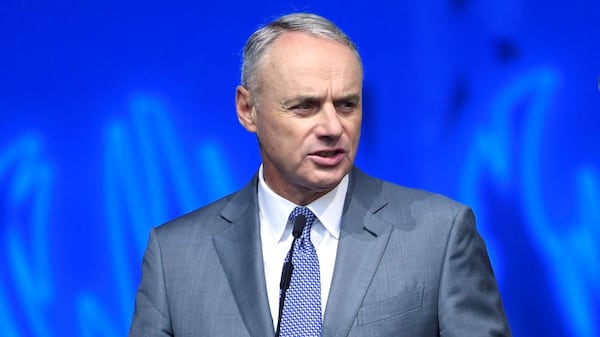
On "The Pat McAfee Show" this week, commissioner Rob Manfred said the gap between the top and bottom payrolls in MLB is $446 million. Is that true?
This is where details matter -- and numbers can be interpreted in different ways.
Did the Dodgers spend $446 million more on players than the Miami Marlins last year? Yes.
Did Dodgers players receive $446 million more in salaries than Marlins players? No.
MLB calculated the figures using a combination of what the Dodgers paid their players ($346 million) plus their penalties for exceeding the luxury tax threshold ($169 million). The Dodgers' tax bill alone was $100 million more than the Marlins' entire payroll ($69 million).
It's true that to field their roster of 26 players, the Dodgers had to pay $446 million more than the Marlins. But the $169 million in tax payments did not go to players. A small portion of all CBT-penalty proceeds goes to funding player benefits. Half of the remaining amount funds retired-player pensions. The other half is redistributed by the commissioner's office to teams whose payroll did not exceed the base CBT threshold.
So, is Manfred wrong when he says that? No. Is it the entire story? No. And that is the first lesson of any collective bargaining negotiation: The details are everything.
Would a salary cap solve the financial inequality?
The simple answer is yes. Hard caps inherently set top and bottom limits, and payroll gaps are thus mitigated.
But is financial inequality what needs to be solved for? That's where the sides disagree. Players believe in the power of as free of a market as they are capable of negotiating. Money spent on players is part of the equation, sure, but teams are defined, players say, every bit as much by other factors: player development, drafting, analytics, coaching, process and a multitude of smaller elements that add up.
The relationship between payroll and regular-season winning percentage is far from linear. The relationship, in recent years, between payroll and winning championships or going deep into the playoffs, on the other hand, is stronger -- and forms the pillar upon which MLB is building its argument for a cap.
Whether a salary cap necessarily creates competitive balance remains an unanswerable question. Other leagues argue that the relationship is causative -- the cap, essentially, ensures balance by precluding teams like the Dodgers or New York Mets from hogging premium talent. The MLBPA argues that other leagues don't have more competitive balance than MLB -- more baseball teams have made the postseason in the past decade than teams in any other sport -- and that even if they did, the relationship would be more correlated than causative.
That's what we do know. What don't we know at this point?
MLB's proposal was scant on details -- and that was by design. Although the league could have offered enticements in an attempt to convert players into salary cap believers -- free agency for all players after five seasons and arbitration for all after two are seen as potentially compelling -- it instead intends to dig into the union's proposal in the days and weeks ahead and negotiate from there.
Still, the questions that remain from MLB's proposal are manifold. Among them:
Where else do the sides differ?
Both sides believe the other's plan does not do what it claims to. In its statement after the union's proposal, the league said the Dodgers actually would benefit to the tune of $70 million more available to spend. Despite the league saying players would make more money under its cap proposal -- 12 lower-spending teams would add $617 million to reach the floor while eight higher-spending teams would cut $578 million to get under the cap -- the union sees the presence of an escrow system as a genuinely mitigating factor that potentially takes money out of players' pockets.
Guaranteed contracts are a beacon for the MLBPA. Almost all NFL deals are non-guaranteed. And the NBA and NHL both use escrow to withhold a portion of player salaries every year. In scenarios where industry revenue does not meet expectations, the leagues can claw back what were supposed to be guaranteed salaries to keep the revenue split as defined. Last year, NBA players forfeited nearly $500 million because of a revenue shortfall. If the league exceeds revenue projections, however, players are not compensated above their contracted salaries.
So, how grim are things really?
Not great! But it's way, way, way too early to panic.
Barring something unexpected that changes the calculus of either side, the next six months are almost certainly going to be a slog toward a lockout. The parties will negotiate because they are legally obligated to, but unless one side changes its fundamental position -- and nothing indicates either will -- the league will lock the players out Dec. 1 and the sport will shut down. No free agency. No trades. No winter meetings. Nothing, just like in 2021.
That lockout ended after 99 days. What's different now is they are negotiating disparate frameworks. And that leads to the most important question of all: How dug in is each side?
If there is no movement in that regard by early March -- if they are still essentially speaking different languages -- the beginning of the 2027 season will be in legitimate danger. And if games are missed for the first time since 1994, the possibility of a prolonged lockout increases drastically and this new gilded age of baseball will come to a screeching halt.
Well, thanks, Debbie Downer. Can we end on some optimism maybe?
Sure! It's actually a decent sign that MLB and the MLBPA agreed that local TV revenue should be shared at a higher rate. And the fact that MLB is willing to put low-revenue teams on the hook for $171 million-plus guaranteed suggests the union's position that those teams could and should spend more has not gone unheard.
At the end of the day, the saving grace in all of this should be what both sides are willing to acknowledge: That the media-rights deal awaiting them after the 2028 season could change the financial outlook for everyone in a mutually beneficial way, and that a work stoppage -- particularly one that lingers -- would do the sort of damage to the game from which it would take years to recover. Perhaps at the end of the day all of this is posturing, performative, an attempt to get the best deal possible, and everyone involved understands that it would be malpractice to look at the game's successes -- the pitch clock and ABS and the World Baseball Classic and TV ratings and international growth -- and kill all of the positive momentum going for the game.
They've got time to figure it out. But the clock is officially ticking.