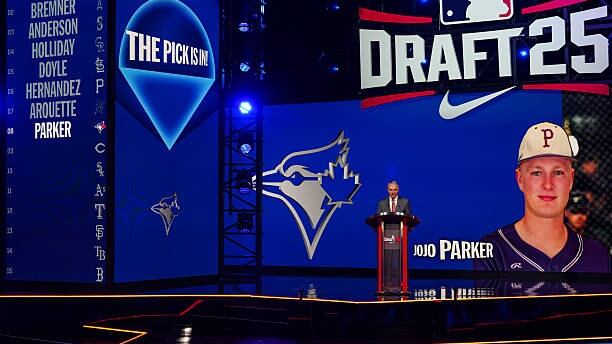
The countdown to the 2026 MLB draft is on.
In the leadup to this year's draft, which begins July 11 in Philadelphia, we'll be using this space for scouting reports, intel and analysis with regular updates throughout the process. In other words, if you want to be in the know as your team's draft plan comes into focus, read on now -- and come back for updates.
Mock Draft 2.0 | Latest draft rankings
June 17: Why UCLA's ace could shoot up draft boards
UCLA right-hander Logan Reddemann (who ranked No. 23 in my most recent draft rankings) is back on the mound for the first time since being shut down with arm fatigue after his April 17 outing.
Reddemann rose a number of rounds this spring by posting a 2.87 ERA with 84 strikeouts over 59⅔ innings in his first season at UCLA and moved into consensus first-round territory around the time he racked up 18 strikeouts over eight innings at Rutgers on April 10 -- before missing the final six weeks of the Bruins' season.
The 21-year-old ace was quietly slated to throw in the winner-takes-all Monday game of the NCAA regional round (June 1), but UCLA was eliminated by Saint Mary's one game earlier. That return on a big stage would have given MLB teams a chance to see if he was back in top form.
Instead, Reddemann will aim to help his draft stock in the coming weeks.
He threw live to UCLA hitters for the first time this week, and I was able to see the pitch data from the 23-pitch outing. He sat 91-94 mph with very similar shape on his four-seamer to his regular-season stuff, understandably a few ticks below his normal 93-97 mph with a bit less extension as he ramps back up to full speed. His off-speed stuff also looked quite similar if not identical in shape, mostly a tick slower than usual, like his fastball.
He has also committed to throwing a bullpen at next week's MLB draft combine in Phoenix along with other top collegiate pitchers.
If Reddemann can prove to scouts that he is back to being the type of pitcher he was for UCLA this season, he is a potential mid-first-rounder in next month's draft.
May 15: How teams really value prospects in 2026
Early in the spring, I noticed my conversations with scouts circling the same general concepts but often dressed up as "this player is rising" or "teams really like this guy ... no, even higher than that" or "oh, he won't go that high, like a round or two lower."
Once I noticed the pattern, I'd start most conversations with evaluators by calling out the trend to see if scouts were seeing the same thing. They were. It breaks down to a few distinct parts that fit together to form a theory behind the recent shifts in scouting and development I'll be referring to a lot in this year's draft process.
1. Big tools are in demand
The shift: The first part was that players with plus tools are being moved up at all junctures of the draft by most teams. It's no secret teams have always liked big tools, but this is now happening even when there also are big questions about a prospect's performance or polish.
Any one player could individually affirm or defy the theory, but teams are playing the odds by applying this logic over thousands of players, with confidence that it will bring them an extra prospect or two and avoid a bust or two compared with how they did things a few years ago.
How it's impacting the 2026 draft: Mississippi prep CF Eric Booth Jr. has, depending on whom you're talking to, some work or a lot of work to do on his swing, but he has arguably the highest upside in the draft because of his bat speed/raw power (plus to plus-plus) and foot speed (plus-plus, maybe even 80-grade for some scouts). Florida prep SS Jacob Lombard can stick at the position and has 30-plus-homer upside, but there are huge questions about his contact rates after he posted some of the worst in the class among the real prospects last summer.
Both are expected to go in the top 10 picks.
Scouts concede that the rankings logic of a few years ago or leaning heavily on a draft model (analytical in nature, one piece of the evaluation pie) would say these players should go much lower. Some models have Lombard outside of the top 20 picks, in the same way some models/draft boards had last year's polarizing prep hitter, Oklahoma prep SS Ethan Holliday, ranked well outside the top 20. Holliday also had a below-average contact rate over the summer and is unlikely to stick at shortstop long term -- and got the highest bonus in the 2025 MLB draft.
2. Lighter tools or smaller physical stature? Maybe later
The shift: Traditionally, top performers with medium physical tools from the best college conferences would go in the top two rounds or maybe the top of the third -- but comfortably in the top 100 picks -- based on their production despite lacking star potential.
The chatter among scouts this spring is that those prospects are falling on draft boards as teams turn to higher-upside players and the performers keep losing coin flips to players with more measurable upside. This extends to accomplished college pitchers with three years of standout performance at big schools in big conferences, playing at the highest amateur level in the world.
Likewise, the Rays, Guardians and Brewers often pounced on smaller players with limited power upside (but strong bat-to-ball and value in speed/defense) as a market inefficiency they could exploit, drafting or signing players such as Vidal Brujan, Tyler Freeman, Taylor Walls, Sal Frelick and Tyler Black and developing them into useful major leaguers.
Recently, those teams seem to have shifted from being the floor for those smaller players to using their early picks on the opposite: bigger-bodied, power-first prospects who are likely to end up in a corner position, such as Andrew Fischer, Jace Laviolette, Nolan Schubart, Xavier Isaac, Brock Wilken, Tre Morgan, Eric Bitonti and Blake Burke.
Has the bottom fallen out of the market for both polished college performers and smaller players with bat control, speed/defensive value and lower overall variance? This draft will be a huge test of that theory.
How it's impacting the 2026 draft: Pitchers such as Clemson's Aidan Knaak, East Carolina's Ethan Norby and North Carolina's Jason DeCaro could be affected because they don't have any single standout tool on the mound. Pitchers who have the potential to provide 150 innings in the big leagues will always have value, but if they're undersized or a righty with a below-average breaking ball, maybe they'll fit more in the third or fourth round than in the top 50 overall picks, as they often did in the past.
Some underpowered hitters who could drop on draft day without the obvious landing spots of past drafts include Georgia Tech's Jarren Advincula, Louisville's Lucas Moore, North Carolina's Jake Schaffner and Oklahoma's Jaxon Willits.
3. Development needed -- a feature, not a bug
The shift: Part of the reason teams are prioritizing tools over production is what we've seen from recent budding stars exemplified by Pirates SS Konnor Griffin and Rays RHP Brody Hopkins.
Scouts have told me that now seemingly every draft room is stuffed with player development personnel weighing in on whom they think they can work with best. Traditionally, player development personnel had far less input in draft decisions -- maybe being consulted on specific picks or given latitude to interject their opinion only in the later rounds when minor league rosters are being filled out. Now, the departments are working much more closely, often with execs overseeing both departments who are actively trying to bring their processes together.
The sales pitch of "big-college Friday night starter over the last three seasons" now doesn't resonate in a draft room as much as "three pitches that grade as plus on your internal Stuff+ model," "used to play wide receiver for the football team" or "because of multisport background, he's still learning how to pitch."
Why? Teams have learned that these narratives create development opportunities along with real MLB and trade value.
Griffin needed a swing adjustment in pro ball. He adapted to that quickly and created nine figures in value for the Pirates in less than a year. It's a reach to think every Holliday, Lombard or Booth is also the next Griffin, but the challenge seems more palatable now.
Hopkins was a former wide receiver and center fielder with Dustin May-like raw stuff at Winthrop but also posted a 5.83 ERA with 44 walks in 54.0 innings in the Big South Conference. A season later, he posted a 3.45 ERA in High-A and was a big part of the Randy Arozarena trade. Last winter, he was No. 86 on my top 100 list, and he is now in Triple-A less than three years after signing for $225,000 in the sixth round.
How it's impacting the 2026 draft: I'm adding to this list by the day. Some interesting college pitchers outside of the top three rounds right now: Jacksonville State LHP Beau Bryans, West Virginia RHP Dawson Montesa, Georgia RHP Dylan Vigue, LSU LHP Santiago Garcia and West Virginia LHP Maxx Yehl.
How this shift impacts the later rounds
Generally speaking, teams have a different process for the top two rounds or prospects in the $1.5 million-plus bonus range than they have for players below that level. Almost every prospect above that line has tools, some performance and a track record and can be judged by a weighted average of these things. Mock drafts and draft-day television analysis often focus on this: a series of positives and negatives in each category.
But teams know they can't get all three qualities from the next tier of prospects, so they focus on players who do one thing they value (i.e. tools that can't be taught, such as velocity, foot speed or raw power), then start drafting players who have a flaw, maybe a few (ideally correctable ones, such as pitch selection or needing a new pitch shape that's similar to one they already throw).
The rising value of middle-round college pitchers
Building on the Hopkins example above, teams are increasingly turning to college pitchers in that next stanza. You can pick any team considered a good pitching organization (in both scouting and development and deployment at the big league level), and it'll have a number of examples of creating value in the low-to-mid six-figure college pitcher demographic.
This player demographic has delivered Cam Schlittler, Bryan Woo, Tarik Skubal, Hunter Brown, Matt Boyd, Jacob deGrom, Joe Ryan, Merrill Kelly, Will Warren, Brandon Pfaadt, and Tanner Bibee. All were drafted in Rounds 5 through 9 from a four-year college.
Although teams prefer the upside of a high school pitcher, those extra three years of amateur experience without the huge developmental breakthrough makes signing college pitchers dramatically cheaper.
The typical overslot high school pitcher after the fourth round will want (give or take) $1 million, but the comps for the college pitchers who became the above pitchers sign for about one-third of that, often even less.
Because teams tend to pile up college pitchers with a good trait or two for $200,000 to $400,000 once all the elite players are off the board, overpaying a high school pitcher with one good trait for a multiple of that price isn't as attractive as it used to be.
"Fixing" a college pitcher can work and immediately create value that can be collected via trade. The Cardinals added a few pitches to Tanner Franklin's arsenal after he was a reliever at Tennessee and cleaned up his delivery. After signing for a little over $1 million less than 12 months ago, he's a top-100 prospect with a surplus value of roughly about 20 times that. This development lens doesn't apply only to players in later rounds, there's just the most value there because the signing cost is so low and the options essentially never end.
Schlittler is another prime example of this. I scouted him at a showcase event in the summer of 2018, before his senior year in high school. He got a $205,000 bonus as a 2022 seventh-rounder out of Northeastern, and I barely thought about him again until his velo started to really creep up in pro ball in 2024 and 2025.
I ran this full concept by some scouts, and they agree that they expect fewer high school pitchers to sign for between $750,000 and $1.5 million than in the past. The rest will go into the college pitcher pool next year, and many might end up falling backward a bit into that low-six-figure college pitcher group in three years.
What it all means for draft rankings
Because of the showcase circuit, advanced data collection and this tweak in preference, accomplished high school prospects with measurable upside now get lumped in with college prospects as the players teams are racing to collect before they run out. Every team's list is a little different, but that group is something like 75 to 100 players (who are actually signable).
Five to 10 years ago, all high school players were seen as a risk, to some degree, and college players were seen as known, to a large degree, with their baseball card performance still holding real value. Teams would often tell me their strategy, all things being equal, was slot or below with college players through the second or third round, then move to overslot high school players until they couldn't afford any more. That's not really anyone's base strategy now.
After those 75 to 100 players are gone, teams will compete to spend their remaining pool space on the best bang for the buck in collecting as many interesting packages of traits as they can find. That's not exclusively college pitchers, obviously, but they are the biggest pool with a diversity of options that basically never runs out.
That shift is subtle enough that you might not even notice it from the outside, and it's been happening behind the scenes for years, with the trend picking up a few more teams each year. The group within a front office that makes high-stakes decisions has been steadily getting smaller, relying on data more and drawing all of the departments (analytics, scouting, player development, sports science, psychological, etc.) closer together into one entity.
The difference of opinion from team to team about a prospect in the minor leagues is lower than in the draft, and in the big leagues it differs very little. Teams now have similar processes and similar information in the draft, but there are still wide swings in opinion on a player (especially beyond the top two rounds) from team to team because of how they balance their preferences and analyze the information. That's the art in drafting players that I think will never become fully scientific, no matter how hard teams try.