Saturday afternoon, college football will kick off on the other side of the Atlantic when North Carolina and TCU meet in the Aer Lingus College Football Classic.
While the Dublin game becoming a yearly Week 0 staple is a recent development, it’s far from the first time the sport has gone abroad. International college football boasts a rather underrated history -- games have been played outside of the United States since the sport’s earliest days.
The Bacardi Bowl was contested a handful of times between 1907 and 1946 in Havana, featuring American universities facing Cuban opponents. Matchups played in Canada by American schools against McGill University and other colleges from across the northern border date back to the 1870s. And who can forget when Missouri took that unsanctioned spontaneous trip to Mexico in 1896 with Texas?
Wait, what?
The games the teams played are not officially recorded by either school -- they were exhibitions -- so the first known college football contests in Mexico exist largely as obscure footnotes in the pantheon of the sport’s lore. But they happened. And the chronicle of Missouri going rogue to play them is wilder than any of the actual on-field action.
College football is a sport that prides itself on championing the obscure and unusual alike. This is a tale that ticks both those boxes, starting with a future attorney’s wisdom and ending with a dismissed coach. In the spirit of college football making its return today on international soil, we went back on a tour of one of those obscure footnotes, reconstructing one of the lesser-known oddities in gridiron history.
Mid-December, 1896: ‘No chance to forbid’
Mizzou’s unauthorized jaunt across the Rio Grande was the byproduct of an unlikely marriage of convenience between opportunity and renegade college spirit.
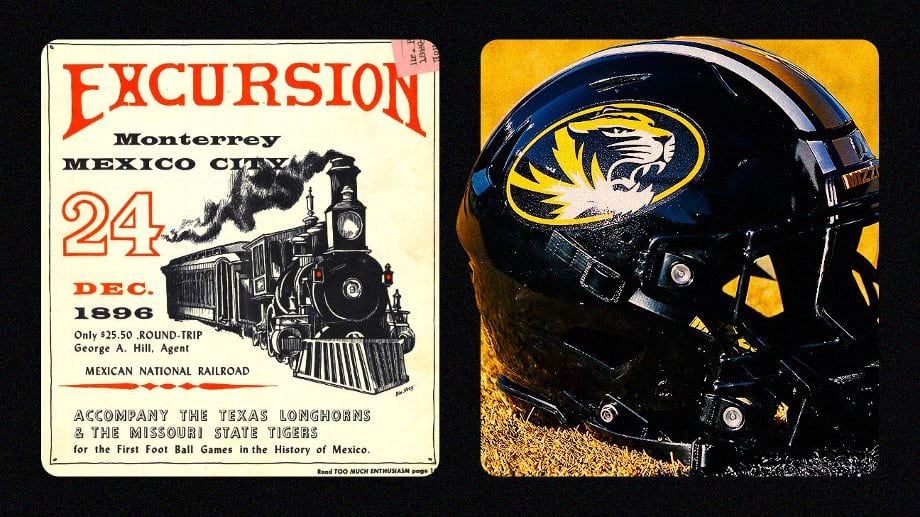
George A. Hill was a man with many a plan. A railroad promoter by trade (while he was identified in one 1921 article as the secretary of the Austin Chamber of Commerce, this title does not seem to be corroborated elsewhere), he had built a brand as a local go-to man for trips south of the border. The Austin-American Statesman described him as “the indefatigable Mexican excursion manager and promoter.”
But touring passengers weren’t the only thing Hill was interested in bringing south. In late 1896, he was plotting to take football to Mexico too.
Hill’s original plan seemed to involve taking the University of Texas squad and something of a regional all-star team on the foreign trip. But the second element still wasn’t solidified that December -- until it fell right into Hill’s lap.
Right around when Hill was dreaming of taking gridiron football southward, Missouri’s squad embarked on a season-ending trip to the Lone Star State. Upon arrival, the Tigers were dominant. In addition to beating the Longhorns 10-0, Missouri played four other games against an assortment of Texan opponents -- city YMCAs and the like -- and won them all by a combined score of 129-0.
If Hill wanted an all-star team, a squad putting forth all-star-like results seemed to have arrived on his doorstep. After Missouri opened its Texan tour with a 28-0 win against Dallas Athletic Club, Hill moved to sign up the Tigers -- and, considering the offer in question included a trip to a foreign country with travel and lodging expenses covered, they were more than happy to oblige. According to the 1897 edition of the Savitar, Missouri’s yearbook, it was a quick and uniform decision from the team.
“After the game the consultation about the Mexico trip was begun,” the Savitar reads. “Mr. Geo[rge] A. Hill, of Austin, was the founder of the scheme, and he, with Mr. Harry O. Robinson, coach of the Texas University team, exposed the plan to the delighted Tigers. The team immediately and unanimously decided to go.”
There was just one small hitch. While Missouri’s squad had permission to travel for the Texas trip, its excused absence was decidedly not indefinite and did not anticipate a further swing across an international border. A holiday season detour to Mexico would blow past any logical “be back by” date. The speed of the Tigers’ affirmative response to Hill, however, helped initially sidestep that problem.
“So delighted were the Missourians that without further ado the proposition was accepted without even so much as an intimation to the faculty of the proposed trip,” wrote the St. Louis Post-Dispatch at the time, noting the “stirred up” nature of the university back in Columbia.
Given that such stirring was foreseen by the team’s leaders in the moment, it’s no surprise that a later retelling of the story indicated that the scant communication back home might have been intentional.
“[Team manager George] English felt sure that the faculty, more than a thousand miles away in Columbia, wouldn’t understand and wouldn’t let the team go if they were asked. So he didn’t ask. He figured that if the faculty didn’t forbid the trip, why, it wouldn’t be disobedience to go. So he gave the faculty no chance to forbid,” the Kansas City Times wrote in 1913, having interviewed English in a revisiting of the story. The Times also dryly added that English went on to enjoy a successful legal career after graduating.
Regardless of potential faculty angst, nothing could practically be done in the moment anyway. The Tigers were more than a thousand miles from campus. Any cables sent toward Austin were in vain.
“As there was nothing to restrain us except college discipline we said we’d love to,” English told The Associated Press in 1921.
And that was that. Missouri & Co. would head to Mexico.
Late December, 1896: ‘Football will probably remain an exotic’
By all accounts, the trip was a memorable one.
Departing on Dec. 23 with roughly a hundred sightseers joining for the journey, Hill and his “sundry Pullman palace cars and other things conducive to a good time” chugged across the Rio Grande en route to Monterrey and Mexico City in style. Even the train came with novelty, featuring a new Pullman dining car service. Once it pulled into the station, the stories -- reported on by the Savitar -- that ensued as the Tigers explored the cities came in droves.
A near-fight was averted after a member of the traveling party said “Good God” (buen dios) instead of “Good Day” (buen día) while looking at a local man. One player was taken aback by naked swimmers in Mexico City pools. Missouri coach Frank Patterson obtained “a fifty cent opal for a dime.”
According to Thomas T. Crittenden, former governor of Missouri and then-U.S. consul general in Mexico City, team members served as fine ambassadors for their university and made the most of the unique experience.
“The boys are making reputations for the Universities -- more than your learned Professors could do in quintriple the time,” Crittenden wrote in a letter to University of Missouri president Richard Henry Jesse preserved in the State Historical Society of Missouri’s archives. “And then this trip is of much education to them -- infinitely more than they could obtain in months there.”
Despite spending a pair of holidays away from home, the mood didn’t seem dampened on either Christmas or New Year.
“This was Christmas night and the whole party was quiet and thoughtful. The young ladies and some of the young men gave a concert. The latest songs were not on the programme but they sang the old songs of childhood. These songs took all back to their homes in spirit and removed some of the regret of spending this holy day so far away from home,” wrote the Savitar, noting that there was a similar party of song, dance and speeches that went “far into the morning” on New Year’s Eve.
In terms of on-field action, the success of the trip was decidedly more mixed. Missouri won the first college football game played in Mexico 12-0 in Monterrey on Christmas Day, with the St. Louis Globe-Democrat reporting an attendance of 3,000, including local governor Bernardo Reyes.
As games No. 2 and 3 were played in Mexico City, though, the novelty of the contests seemed to have worn off. There had been pre-trip talk that Mexico’s then-president Porfirio Díaz would attend, but he didn’t. The new game competed, unsuccessfully, with bullfighting for attention.
The matchups weren’t exactly conventional showdowns, either. Multiple accounts reported that the teams’ rosters had been mixed. A 1957 edition of The Alcalde, Texas’ alumni magazine, contains an excerpt from a letter reportedly written by Missouri player Adam Hill about the games.
“We played a mixed team,” wrote Hill (of no relation to the excursion promoter). “During the games we would interchange players; and even the coaches, Harry Robinson of Texas and [Frank] Patterson of Missouri, joined in and played.”
Mexico City’s high altitude was also a factor in some less-than-thrilling gameplay.
“The great elevation was seriously felt by the players, who easily lost their wind,” reported the San Antonio Express News after the third game, a 0-0 draw. And after the second, the Austin-American Statesman ran a report from The Mexican Herald, a local English-language paper, that spoke to a general lack of interest.
“[The Herald] says that it is not likely that so violent and muscular a game will be introduced here and football will probably remain an exotic, as far as Mexico is concerned.”
So Missouri, Texas and the sightseers headed back to the U.S. with plenty of memories, but not much in the way of success as sporting diplomats. When they reached Laredo, Texas, a missed connection forced an extended overnight layover until the next train arrived. So they did what was only right.
They played more football ... and then took the competition to the bowling lanes. Mizzou won both.
“In the meantime a football game was played and one evening was spent at the Laredo Club,” the Savitar reads. “Where the Missouri bowling team defeated the Texas bowling team, both being organized on the spot.”
January, 1897: ‘The committee recommends ...’
The Tigers racked up athletic triumphs, but perhaps their toughest opponent was still on the horizon when they finally hopped the train back to Missouri.
When the team returned to campus, rumors were circulating that the rogue squad would face punishment. Compounding the runaway team’s potential troubles was the fact that two players by the names of Buchholz and Lewis, who weren’t on the team’s usual roster -- nor were they students at all -- had gone with the team to Texas.
Buchholz was on Missouri’s team the previous year, and Lewis -- purportedly said by Buchholz to be the “toughest and meanest football player who ever lived” -- was reportedly a practicing physician. Both had been playing in Kansas City that fall, and joined the Tigers ahead of their departure south. The concept of non-students or rostered players competing with college football teams was not unprecedented for the era, but the charge still existed.
The threat of repercussion loomed.
But the maverick Missouri squad was not without champions. The pro-team caucus was a legitimate one, with particular strength among fellow students. One player reportedly claimed that, should the team be expelled, “there are 300 students who will leave with us.”
Support also came from an unconventional advocate in Mexico -- Crittenden, the former governor, evidently had been aware of the possible consequences the team could face upon return, and included in his letter to the university president a specific backing of the team.
“I have been induced to write this to you without [the team’s] knowledge -- from having seen in some paper -- the Faculty of the Missouri University would in some way hold the young gentlemen responsible for any infraction of some rule or other,” Crittenden wrote. “As an old friend of the University and of education I have written this letter, -- [on] behalf of the boys. They have made the trip of their lives, -- (free of cost) -- which is a part of the broadest and most practical education.”
Regardless of the support, the team didn’t have much of a defense for its actions, though that wasn’t for a lack of inventive thought.
“The team has found a scriptural injunction to sustain them in the Sunday game [the Sunday game ostensibly being them facing the discipline committee]: ‘When in Rome, do as Rome does,’” reads one dispatch from the Missouri Statesman in the university’s archives. “At least the Statesman [reporter], who is not versed in holy writ, takes the Tigers word for the existence of such a text, although the informant has forgotten its exact whereabouts in the Bible.”
Biblical roots of “When in Rome” aside -- while the phrase does not appear in the Bible, its coining is attributed to the former Bishop of Milan, Saint Ambrose -- its insight couldn’t help the Missouri squad fight the charges. Despite a strong amount of future legal chops among its leaders (in addition to English, Patterson would also go on to become a lawyer), it was an open-and-shut case. The team was guilty and pleaded as such.
It didn’t take long for a decision. The majority of those involved were spared punishment. But for Patterson, English and team captain Tom Shawhan, the consequences were serious. The St. Louis Globe-Democrat printed the following resolution, adopted by Missouri’s discipline committee in mid-January 1897:
“‘That Coach Patterson was responsible for bringing Buchholz and Lewis to Columbia, for taking them on the Southern trip, and for playing them in the games; that, though he knew the action of the council, he failed to notify the team of the action of the council, forbidding the taking and playing of these men.
“Therefore, the committee finds that Mr. Patterson has been guilty of most reprehensible conduct, and recommends that he be debarred from any further connection with any of the organizations of this university.
“That Capt. T. R. Shawhan was guilty of taking and playing these men, knowing that this was forbidden by the council. The committee would recommend that Mr. Shawhan be suspended indefinitely from the university.
“That Manager George H. English protested against taking the men on the trip, but that he was guilty of gross neglect of duty in taking along and playing two men who were not students, and in not communicating with the university authorities with reference to the Mexico trip. The committee recommends that Mr. English be suspended from the university indefinitely from January 26, 1897.
“That the remaining members of the team were not responsible for the taking and playing of Buchholz and Lewis; that they supposed they were excused for the Texas trip: that they were ignorant of the Mexico trip till they reached Dallas, and, influenced by the advantages offered by this journey to Mexico, they went, though they knew they were violating a council rule in so doing. The committee recommends that they be reprimanded by the president for this breach of university law.’”
Frank Patterson, head coach of Missouri for all of one season, had coached the Tigers for the last time.
Postscript: ‘Merely gave me a week’s holiday’
You may have noticed that only Patterson was mentioned in the final sentence of the previous section. That’s for a reason: The punishments faced by English and Shawhan didn’t really stick.
Shawhan and English were eventually readmitted. Although the captain never suited up for the school again, he was back around the team helping the new coach by later that year. Patterson’s story didn’t end poorly either -- after trading the coaching profession for law he went on to enjoy an accomplished career in New York.
But English enjoyed perhaps the best perspective on his consequence: It was essentially a free vacation.
“My suspension, however, was not such a severe penalty,” he would go on to say. “It was made effective during the week of mid-year examinations, and as my standing was luckily good enough to pass in all my courses without examination, it merely gave me a week’s holiday while everyone else was ‘boning’ for exams.”