Perhaps the Montreal Canadiens survived Game 7 Sunday night in Tampa Bay more than anything else – it’s not often you see a team with nine total shots in an elimination game live to talk about it, but that’s precisely what happened.
Now Montreal sits four wins from the Eastern Conference Final, with another division rival standing in their path.
Dispatching a team the quality of the Tampa Bay Lightning was no small feat; after seven games the daylight between these two teams was non-existent. Power-play goals were five apiece; the Canadiens were one goal better at even strength, outscoring the Lightning 11-to-10.
But goaltending is heavily deterministic in outcomes of series come playoff time, and there is no doubt Jakub Dobes outplaying Andrei Vasilevskiy was the ultimate difference maker. In fact, one could argue the only goalie who showed better in the first round of the Stanley Cup Playoffs was Carolina’s Frederik Andersen:
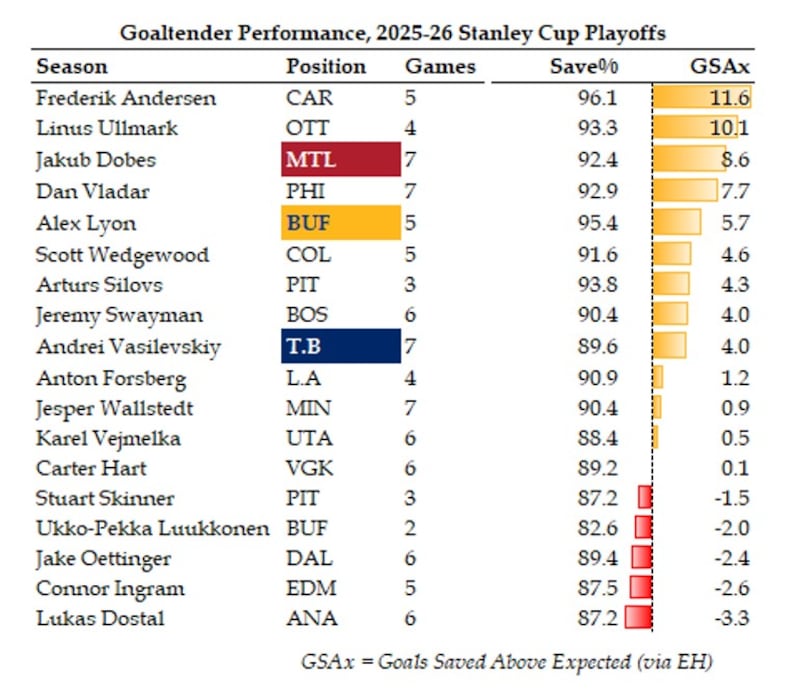
When two teams are this close in quality, goaltending is going to be the difference more times than not. Tampa Bay might have had more of the puck throughout the series – and especially in Game 7 – but Dobes’ 28 saves on Sunday were enough to get the job done.
It goes without saying that Montreal will need Dobes to outplay Alex Lyon and Buffalo in the second round. But to dispatch this Sabres team, Montreal urgently needs to get its top line going.
It’s been rare, perhaps exceptionally rare, that Montreal’s young guns at the top of the lineup have been held in check like they were against Tampa Bay.
The main reason Montreal was so competitive all year (including a late-season bid for the divisional crown) was because of their dynamic trio at the top of the lineup. Cole Caufield, Nick Suzuki, and Juraj Slafkovsky formed one of the league’s deadliest lines all season long; a terrifying combination of playmaking ability and finishing skill that can get to opposing defences in a hurry.
That was not the case against Tampa Bay. The Lightning threw a heavy dose of Anthony Cirelli, Brandon Hagel, and Nikita Kucherov against Montreal’s best line (with a lot of J.J. Moser and Darren Raddysh behind them) and had tremendous success.
The Canadiens’ top line was four goals underwater in the series. Without the trio of Alex Texier, Kirby Dach, and Zach Bolduc outscoring Tampa Bay 6-0 (+6) in their minutes, we might not be talking about Montreal making a second-round appearance:
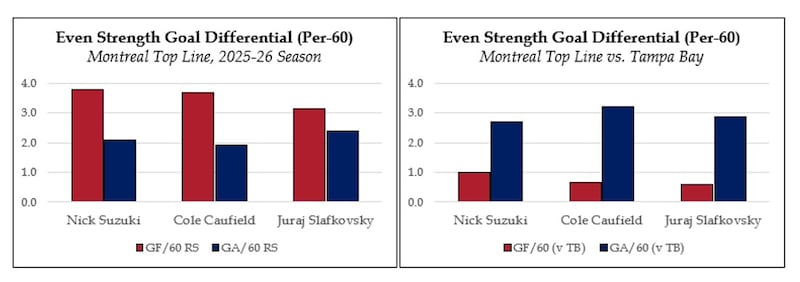
Given their track record of success over the past several seasons, it’s easy (and likely fair) to chalk this up as a one-off – the Lightning are one of the few teams in the league with the personnel to match up against Montreal’s best, with players like Hagel and Cirelli in particular known for their incredible defensive prowess.
And part of winning in the postseason is not relying on the same few players to outperform every single night; if that were the case, the Connor McDavid and Leon Draisaitll-led Edmonton Oilers would have multiple Stanley Cups by now.
Give credit to Montreal’s depth for picking up the slack when the team needed it most. But the Canadiens are going to need more from their big guns if they want to upset the Sabres in round two.
Buffalo is a different sort of problem for Montreal; they may not have an elite five-man matchup unit a la Tampa Bay, but they have incredible depth and will be able to roll three lines and three pairings confidently, just like they did against the Boston Bruins in the first round.
Buffalo is not a perfect team but you won’t find many lineups deeper than this group; that’s going to create problems for Montreal’s depth players, too.
In short: Montreal survived the first round on elite goaltending and depth scoring. Advancing against a team like Buffalo will require their star trio to reclaim their dominance.
Data via Natural Stat Trick, NHL.com, Evolving Hockey, Hockey Reference