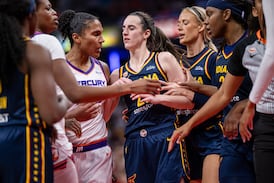
There are more eyes on the WNBA now than ever. Viewership and attendance numbers are at an all-time high. The boost in popularity has led to more media coverage and more scrutiny of the physical exchanges taking place on the court.
The 2026 season has seen its share of dust-ups. During a game in June, Phoenix Mercury forward Alyssa Thomas pressed her fist into the throat area of Indiana Fever guard Caitlin Clark during a scramble for a loose ball. To the dismay of Fever coach Stephanie White, the game’s referees did not call a foul on the play. White blasted the non-call as “egregious and utterly disrespectful.”
Following postgame evaluations, the league office reviewed the footage and retroactively upgraded the contact to a flagrant foul 2. Thomas received a mandatory one-game suspension.
In August, White and the Fever again found themselves in the middle of an incident when Chicago Sky guard DiJonai Carrington hit Fever guard Sophie Cunningham across the head and neck area during their game in Chicago. Referees upgraded the foul from a flagrant 1 to a flagrant 2, resulting in an ejection of Carrington.
Carrington’s foul ignited a firestorm on social media and in the stands, as some Fever fans later booed White, feeling she didn’t show enough support for Cunningham. That caused White to unleash an emotion-laced monologue in her defense.
As the physicality continues in the WNBA, so will the hard fouls. To inform fans about the WNBA rules of conduct, here’s a breakdown of fouls in the league and how they’re regulated:
What is a personal foul?
Not all personal fouls are the same in the WNBA. Common fouls are personal fouls that happen regularly throughout a game. Each player is allowed five personal fouls. They are disqualified from the game on the sixth personal foul.
What is a flagrant foul?
Flagrant fouls occur less regularly, thus resulting in a harsher penalty than personal fouls.
An official will assess a flagrant foul 1 if the contact is deemed “unnecessary.”
The WNBA rulebook outlines a flagrant 1 as follows:
“Rule 12B, Section IV-a.: If contact committed against a player, with or without the ball, is interpreted to be unnecessary, a flagrant foul-penalty 1 will be assessed. A personal foul is charged to the offender and a team foul is charged to the team.”
A flagrant 1 results in two free throws for the player who is the object of the foul, and that player’s team is awarded possession of the ball.
A player is automatically disqualified from the game after committing two flagrant fouls.
An official will assess a flagrant foul 2 if the contact is deemed both “unnecessary” and “excessive.”
The WNBA rulebook outlines a flagrant foul 2 as follows:
“Rule 12B, Section IV-b.: If contact committed against a player, with or without the ball, is interpreted to be unnecessary and excessive, a flagrant foul-penalty 2 will be assessed. A personal foul is charged to the offender and a team foul is charged to the team.”
A flagrant 2 results in an immediate disqualification.
Check out the ESPN WNBA hub page, which features breaking news, in-depth player profiles, scores, stats, schedules and more.