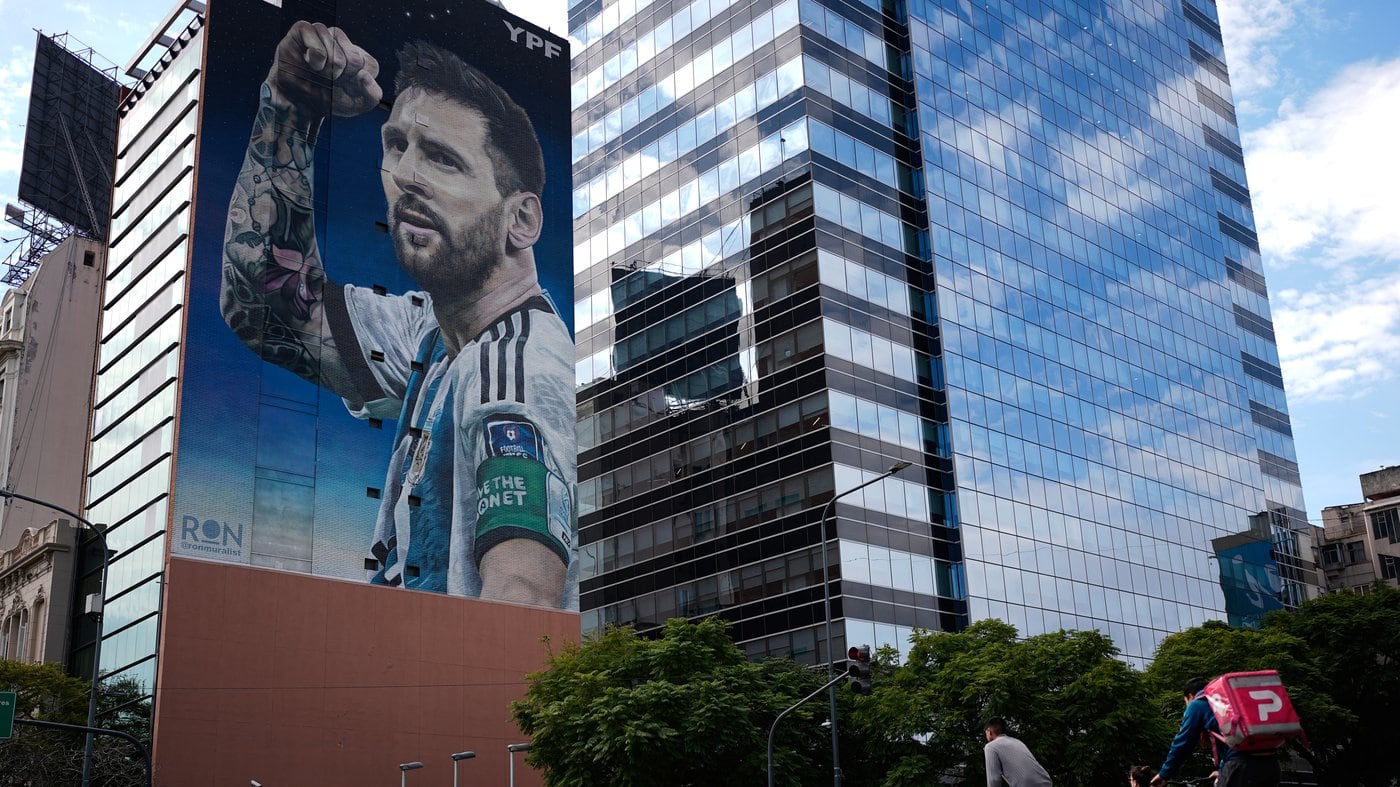
BUENOS AIRES (AP) — What now for Argentina?
Lionel Messi announced his retirement from the national team on Monday after a 21-year career, leaving behind a legacy of 125 goals and the 2022 World Cup title. As captain and talisman, his departure raises big questions about the future of a team that reached the World Cup final just six weeks ago.
“I gave it my all; I have nothing left to give,” Messi wrote in an Instagram post. “Besides, there are young players coming up who deserve to be here.”
Messi made his senior debut in 2005, went on to become Argentina’s all-time leading scorer, and appeared in six World Cups. He holds the records for both the most games played (34) and most victories (23) in the history of the tournament.
At 39, the end of Messi’s international career was imminent. Yet, the official confirmation struck a emotional chord with teammates and fans alike — especially the younger generation who grew up watching him wear the Albiceleste colors.
“I was just a kid, calculating the age gap between us to see if I might one day get to play alongside you,” said 25-year-old midfielder Enzo Fernández, who debuted just months before the Qatar World Cup. “It’s hard for me to picture the next training camp without you — stepping onto the pitch and not seeing you up front in that No. 10 jersey. ... We’re going to miss you dearly, Captain.”
The search for an heir
Can Argentina’s inexhaustible talent pool produce another global megastar?
The same question arose in 1994, when Diego Maradona’s time with the Albiceleste came to a traumatic end following a positive drug test at the World Cup in the United States. More than a decade passed before a player capable of claiming his throne emerged, and it took 36 years for Argentina to lift the trophy again.
“Argentina has a deep-rooted culture. Players grow up learning the craft on the street and at local clubs; football permeates everything,” said 1986 World Cup champion and sports columnist Jorge Valdano in an interview with The Associated Press last May.
“In that environment, a genius is far more likely to emerge. But to become Messi, you need to win both the genetic lottery and the social lottery,” Valdano added.
There is currently no player who matches Messi’s technical brilliance. However, several young prospects are competing for the playmaker role in the Argentina team.
Nico Paz and Thiago Almada both shared the pitch with Messi at the recent World Cup, though neither quite dazzled. Paz was named the best midfielder in Serie A last season with Como, while Almada, who started early in the tournament before being relegated to the bench, recently left Atlético Madrid to join River Plate.
Argentina used to winning without Messi
In the twilight of his career, hampered by recurring physical issues, Messi missed more than 20 national team matches. Yet Argentina maintained a winning record without him. During World Cup qualifying, manager Lionel Scaloni adjusted tactically, regularly pairing center-forwards Julián Álvarez and Lautaro Martínez, while turning to Almada and Paz to step into the traditional No. 10 role.
Even so, Messi’s pivotal performance at the recent World Cup — where he repeatedly rescued an Argentina side that struggled collectively — underscores just how difficult he will be to replace.
The future of the “Scaloneta”
Messi’s successor is not the only question mark hovering over Argentina’s future.
Coach Lionel Scaloni — the architect of the most successful era in Argentine football history that also included two Copa America titles — hinted that he might step down at the end of the year following Argentina’s loss to Spain in the World Cup final.
With his captain officially retiring, retaining Scaloni — whose contract runs through December — is vital to guiding the squad through this transition. Their first major test will be the 2028 Copa America.
Fortunately, much of the core roster remains young enough to still be in their prime at the 2030 World Cup, which Argentina will partially co-host. Key pillars include defenders Cristian Romero and Lisandro Martínez (both 28), full-back Facundo Medina (27), midfielders Enzo Fernández (25), Alexis Mac Allister (27), and Valentín Barco (22), alongside forwards Giuliano Simeone (23) and Julián Álvarez (26).
Scaloni, who currently resides in Spain, is set to arrive in Buenos Aires in the coming days to plan upcoming friendlies scheduled for late September, October, and November. The Argentine Football Association (AFA) has yet to confirm the opponents.
___
See AP’s full soccer coverage here
Débora Rey, The Associated Press