A double sweep to open the National Hockey League playoffs hasn’t happened in more than 40 years. But after humbling the Ottawa Senators and Philadelphia Flyers in lightning-quick fashion, the Carolina Hurricanes look primed to finally win a Stanley Cup.
That’s not to say the road doesn’t get tougher from here — a collision course with the Colorado Avalanche would, in all certainty, give us the best-on-best Stanley Cup the hockey world craves.
Detractors have been quick to point to underwhelming competition in the first two rounds –especially a Flyers team that looked young and rattled for a second-round foe. But I think that discounts too much of what Carolina does to teams when they’re at their best, and that’s bringing offences to a screeching halt.
The Hurricanes’ defensive numbers through the first two rounds are staggering, and frankly a phenomenal reminder that one of the benefits of dominating possession is your opponent simply spends a lot of time trying to win the puck back.
Over the eight games against the Senators and the Flyers, the Hurricanes won the scoring battle at even strength16-6 (+10). Just as remarkable: opponent power plays are only one goal better than Carolina over that same eight-game stretch; the goal differential for Carolina’s penalty kill is just -1.
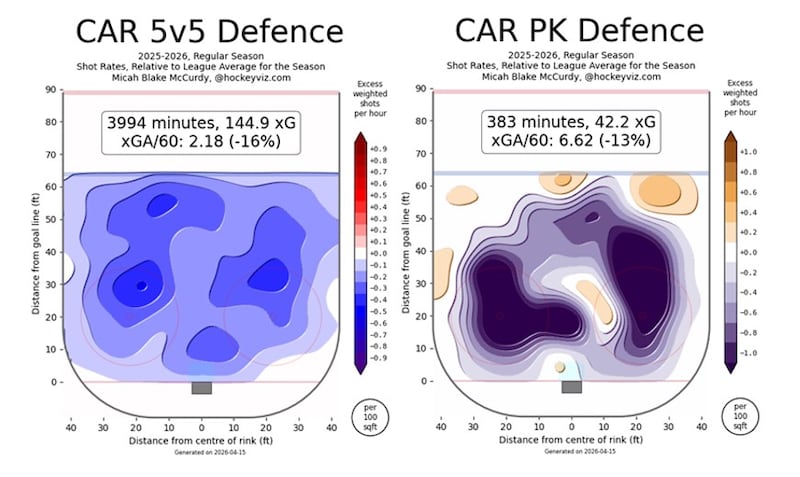
Six even-strength goals against in eight games is remarkable but in line with what we witnessed from this Hurricanes team all season (and in prior seasons past as well). It is simply very difficult to even get the puck into Carolina’s zone, and in the oft chance teams do, it’s another task entirely to try and create scoring chances from the dangerous areas of the ice.
Carolina’s personnel play tightly within structure and are exceptional at keeping opposing forwards on the perimeter. We observe the same relationship on the penalty kill, where a four-man unit of Jordan Staal, Jordan Martinook, Jaccob Slavin, and Jalen Chatfield can completely shut down the game.
Said another way, Carolina defensive zone is hockey’s Bermuda Triangle (heat maps via HockeyViz):
Watch a Carolina game, and one thing becomes crystal clear: This team will forecheck you into oblivion, and inexperienced teams can struggle mightily against the pressure.
One of the parts not lost on me from the first two rounds was how many quality forwards from both Ottawa and Philadelphia found zero space to operate against Carolina’s vaunted defence. In fact, if you look at the forward groups of both teams and compare their shot volumes from the regular season versus their head-to-head matchup with Carolina, there is a staggering drop-off from most:
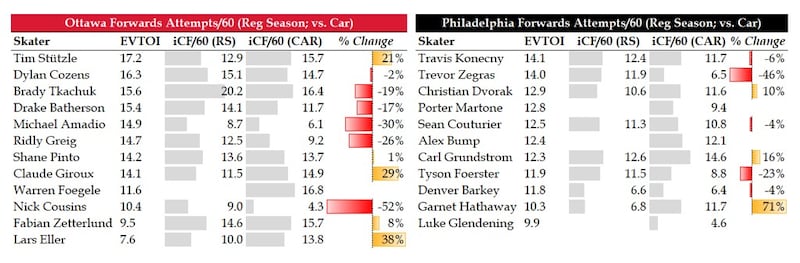
It’s not just that so many players had such decisive, double-digit drop-offs in opportunity, it’s that Carolina also did it to some of the most dangerous players on the ice.
Skaters like Brady Tkachuk, Drake Batherson, Travis Konecny, and Trevor Zegras were bottled up. The only two consequential skaters who outperformed were Tim Stutzle and Christian Dvorak, and that outperformance is only a function of shot volume; Stutzle was blanked at evens in four games against Carolina, and Dvorak had just one helper. (It goes without saying that the last thing you want to see are depth forwards like Lars Eller and Garnet Hathaway being leaned on to generate offensive pressure, which also was the case).
Sprinkle some great goaltending behind all of it through Frederik Andersen and his absurd .950 save percentage, and you can see why Carolina has broomed the competition.
Ask anyone in the Hurricanes organization and they’ll tell you the job isn’t finished. Few teams have more postseason wins than Carolina over the past decade, and yet they still haven’t raised the Stanley Cup since 2006. There’s been a tortured history there of late, especially in the Eastern Conference Final. Carolina has been here two of the past three years, with both of those bids ending unceremoniously against a better Florida Panthers team.
But those Panthers have long been vanquished, and whether it’s the Buffalo Sabres or Montreal Canadiens as their third-round opponent, Carolina will be the favourite to advance.
Is this the year Rod Brind’Amour’s team finally gets it done?
Data via Natural Stat Trick, NHL.com, Evolving Hockey, Hockey Reference